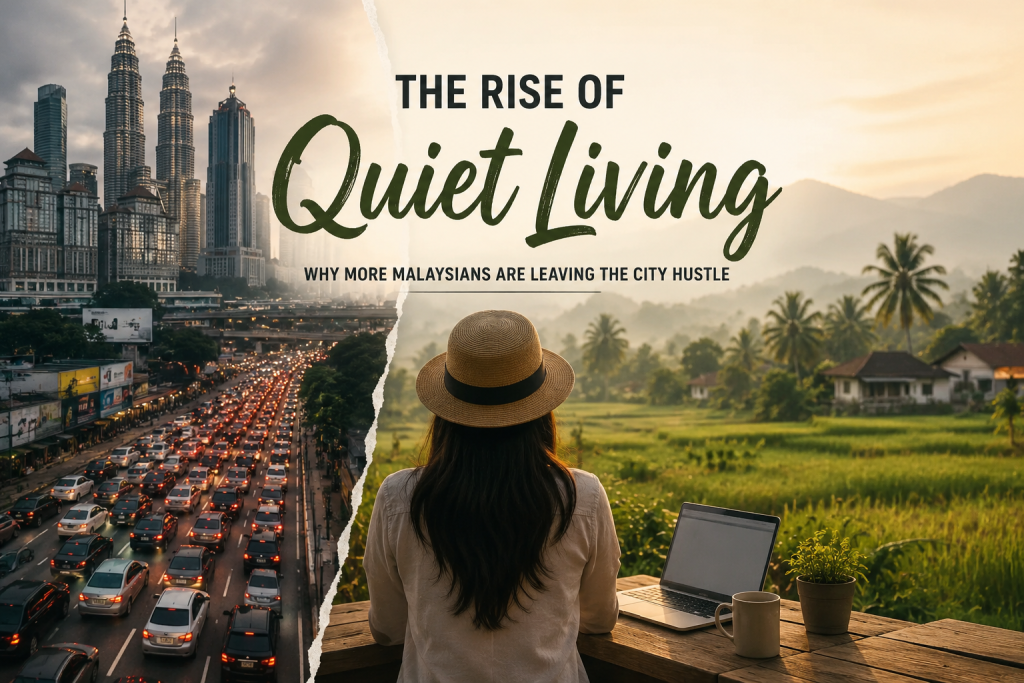
In recent years, a subtle but noticeable shift has been taking place across Malaysia. While Kuala Lumpur and Selangor remain the country’s economic engine, more Malaysians are beginning to question whether the fast-paced city lifestyle is still worth the rising cost, long commutes, and constant pressure that come with it.
Instead, a growing number are choosing what many now call “quiet living” — a slower, more intentional lifestyle in smaller towns such as Kedah, Perlis, Melaka, and parts of Pahang and Negeri Sembilan. It is not necessarily about escaping the city, but about redefining what “a good life” means. 
From city lights to slower mornings
For many young professionals, life in Kuala Lumpur once symbolised success. High-rise apartments, café culture, and career growth were part of the dream. But for some, that dream has started to feel increasingly expensive — both financially and emotionally.
“I used to spend almost two hours just travelling to and from work,” said a 32-year-old marketing executive who recently moved from Petaling Jaya to Melaka. “Now I wake up later, I have breakfast with my family, and I actually feel like I have time to live.”
This sentiment is becoming more common, especially among those who can work remotely or on hybrid arrangements. The COVID-19 pandemic accelerated this shift, but even after restrictions ended, the flexibility it introduced has remained.
The cost of living reality
One of the strongest drivers behind this movement is cost. Rent in KL and surrounding urban areas has steadily increased, while daily expenses — from parking to food delivery — continue to add pressure.
In contrast, smaller towns offer a different equation. Housing is more affordable, traffic is lighter, and even simple routines feel less rushed. For many families, the decision is no longer just about income, but about quality of life.
A young couple who relocated to Alor Setar shared that their monthly expenses dropped significantly after leaving the Klang Valley. “We don’t feel squeezed every month anymore,” they said. “We can actually plan for the future instead of just surviving the present.”

Remote work changing the map of opportunity
The rise of remote and hybrid work has quietly reshaped where Malaysians can live. Jobs in digital marketing, IT, design, customer support, and freelance work no longer require a daily physical presence in the office.
This has opened the door for a new kind of migration — not overseas, but inward, toward smaller Malaysian towns that were once seen as “backward” or “too quiet.”
Now, places like Melaka, Taiping, and Kangar are seeing a different kind of resident: professionals with laptops, stable internet connections, and a desire for balance rather than constant acceleration.

Mental health and the need to slow down
Beyond money and logistics, mental health is becoming an increasingly important part of the conversation.
City life, while exciting, can also be exhausting. Traffic congestion, noise, long working hours, and the pressure to constantly “keep up” have led many to experience burnout without even realising it.
Psychologists have noted that prolonged stress in urban environments can lead to fatigue, anxiety, and emotional detachment. Quiet living, on the other hand, is often described by those who adopt it as “mentally lighter” — not because life becomes problem-free, but because the pace allows space to breathe.
One resident who moved from Shah Alam to Perlis described it simply: “I didn’t realise how tired I was until I stopped rushing every day.”
Not an escape, but a recalibration
However, quiet living is not without trade-offs. Smaller towns may offer peace, but they can lack the career opportunities, entertainment options, and infrastructure found in major cities. For some industries, physical presence in urban centres is still essential.
That is why many see this trend not as an escape from the city, but a recalibration of lifestyle priorities. Some choose to split their time between both worlds — working in the city during certain periods, and returning to quieter hometowns when possible.
Others are redesigning their careers entirely to fit a more location-flexible life.
The future: Malaysia’s new lifestyle balance
As Malaysia continues to develop digitally and economically, the definition of success is slowly changing. It is no longer only about climbing corporate ladders in skyscrapers. For many, it is about waking up without stress, having time for family, and living in a space that feels manageable.
The “quiet living” movement reflects a broader truth: Malaysians are not rejecting ambition — they are redefining it.
And as more people begin to ask whether city hustle is worth the price, the answer is becoming less uniform. For some, Kuala Lumpur will always be home. For others, a quieter corner of Malaysia might be where life finally feels like life again.
— MINUTESMY / SUGAN BALAN