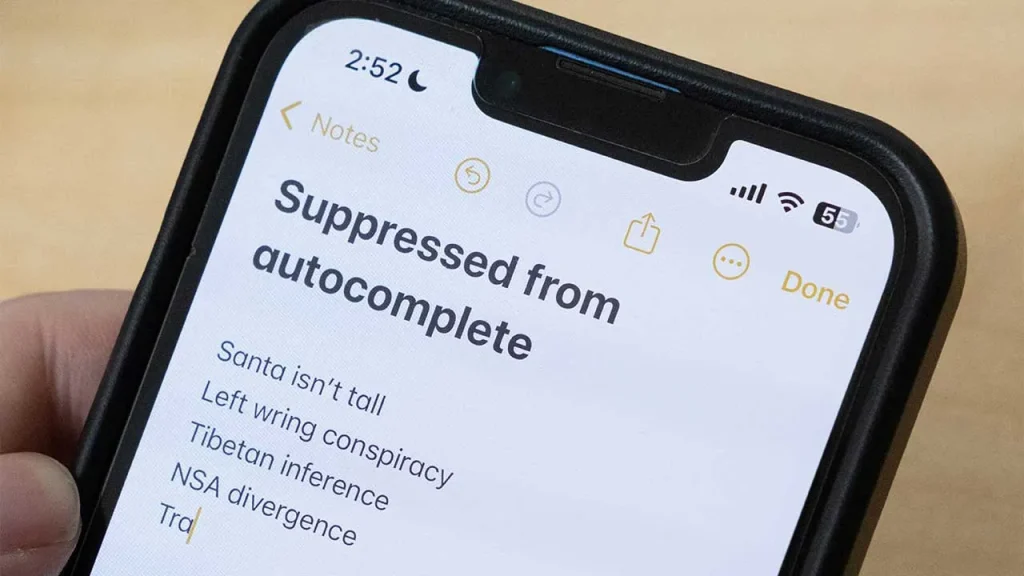
WASHINGTON, Nov 6 – Apple’s iPhone keyboard reportedly restricts certain words and political phrases from appearing in its predictive text suggestions, according to an independent researcher who uncovered a hidden list within the company’s operating system.
The list reportedly includes phrases such as “Dictator Trump” and “Sleepy Joe”. However, this does not mean Apple has banned users from typing them.
Instead, the keyboard limits how these expressions appear through autocomplete and swipe-typing features.
Researcher Discovers Hidden List of Restricted Phrases
Independent researcher Derik Kauffman discovered the list after noticing that his iPhone struggled to recognise certain words when he used swipe-typing.
Swipe-typing allows users to enter words by sliding their fingers across the keyboard instead of tapping individual letters.
Kauffman investigated the issue and found a collection of restricted words and phrases within Apple’s operating system. He estimates that the list contains around 100,000 entries, excluding Chinese characters.
Most entries involve offensive language or terms related to drugs, sex and violence. However, the list also includes political expressions and controversial topics.
Examples include “right wing conspiracy”, “Tibetan independence” and “United Ireland”.
The restrictions also vary across languages. For instance, Kauffman identified phrases involving Indian political figures in Hindi, immigration in French and territorial issues in Hebrew.
Apple Says Users Can Still Type the Words
Apple did not directly confirm the list’s estimated size or explain why it flagged specific political phrases.
However, the company said users can still type any words they want. They can also override predictive text suggestions.
Apple explained that its keyboard aims to avoid suggesting words or phrases that could appear offensive or inappropriate.
Meanwhile, Kauffman questioned the consistency of the filtering system.
He pointed out that the keyboard could recognise some expressions but struggle with similar phrases. For example, “read smut” worked through swipe-typing, while “read gay smut” did not.
Reuters also tested several phrases and found that the keyboard often replaced them with different words.
For example, swipe-typing “Sleepy Joe” produced “Sleepy hope”. Similarly, “United Ireland” sometimes appeared as “United Iceland”.
Researchers Raise Concerns Over Digital Censorship
Kauffman described the filtering system as a light form of censorship. He argued that even small changes to predictive text could influence communication because millions of people use iPhones.
Another technology expert, Matt Suiche, independently recovered the list and said his findings closely matched Kauffman’s results.
The discovery has also raised questions about transparency and user control.
David Greene, senior counsel at the Electronic Frontier Foundation, said companies should inform users when their technology filters certain expressions.
He acknowledged that filtering offensive suggestions could serve a purpose. However, he believes users should understand how the system works and have some control over it.
Apple’s Predictive Text Faces Fresh Scrutiny
This is not the first time Apple’s predictive technology has attracted public attention.
Last year, some users reported that their iPhones briefly displayed the word “Trump” when they dictated the word “racist”.
Apple later described that incident as a software error and said it had fixed the problem.
The latest discovery has renewed questions about how technology companies manage language suggestions and sensitive content.
Although Apple’s keyboard does not prevent users from entering the flagged phrases, researchers say greater transparency could help users understand how predictive text influences everyday communication.
Source : AWANI | Rewritten By Minutesmy