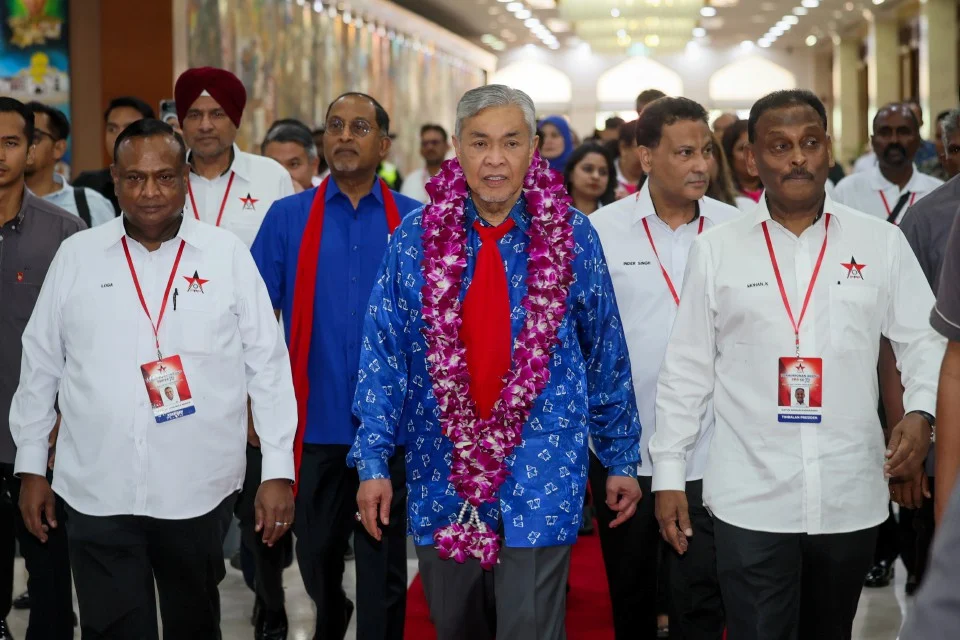
![KUALA LUMPUR, March 31 — Malaysia has entered a new era in labour protection with the enforcement of the Gig Workers Act 2025 [Act 872], marking a major milestone in safeguarding the rights and welfare of workers in the rapidly expanding digital economy. The landmark legislation, which officially comes into force today, reflects the strong commitment of the MADANI Government under Prime Minister Anwar Ibrahim to ensure that economic progress goes hand in hand with social justice. Described as a bold and comprehensive move, the Act provides long-awaited legal recognition and protection for gig workers, a sector that has grown significantly in recent years due to technological advancements and shifting employment trends. With an estimated 1.64 million gig workers in Malaysia set to benefit, the law introduces key safeguards including basic workers’ rights, improved transparency in contractual agreements, clearer dispute resolution mechanisms, and stronger social security protections. Officials подчеркнули that Malaysia’s approach places it ahead of regional peers such as Singapore, Indonesia, and Philippines, where gig worker protections are still being introduced gradually or remain limited to specific sectors. In contrast, Malaysia’s dedicated legal framework positions the country among Asia’s leaders in addressing the challenges of the gig economy. The Ministry of Human Resources, Ministry of Human Resources Malaysia, played a central role in developing the Act, working closely with a wide range of stakeholders including gig worker associations, trade unions, academics, and media representatives. “This is not just about economic growth, but about fairness and inclusion,” the government said, emphasizing that the goal is to build a digital economy that is not only innovative and fast-growing, but also equitable and sustainable. The introduction of Act 872 is seen as a defining step in positioning Malaysia not merely as a participant in the regional gig economy, but as a model nation demonstrating that technological advancement and social protection can progress together. The government expressed appreciation to all parties involved in shaping the legislation, noting that the achievement reflects a collective national effort to secure a more just and resilient future of work.](https://minutesmy.com/wp-content/uploads/2026/03/657983552_122263032920166941_1934844252325807125_n-1024x683.jpg)
The heated exchange at the Johor PKR Convention should not be reduced to mere personality clashes—it reflects a deeper question about loyalty, responsibility, and the proper way to defend a political party.
In this context, Ramanan Ramakrishnan was right to take a firm stand.
When Ramanan said, “YB, you should defend the party. This party is our house. If you want to save the party, then you should not attack the party. That is not fair,” he was not silencing debate—he was calling for discipline.
A party convention is not just another for political sparring; it is a space meant to consolidate strength, reaffirm direction, and present unity, especially in front of grassroots members who look to leadership for guidance.
Critics may argue that his remarks toward Rafizi Ramli were too direct, or that Hassan Abdul Karim was justified in defending a colleague not present.
But that framing misses the larger point. Ramanan’s intervention was not about personal attacks—it was about drawing a line.
When internal criticisms begin to echo publicly in ways that can weaken party confidence, someone must step forward to say: enough.
Political maturity is not only about allowing criticism—it is about choosing the right forum and tone. Ramanan emphasised that difference.
If debates are to happen, they should occur through structured channels, not through statements that risk eroding trust among members and supporters.
In that sense, his stance aligns with organisational responsibility, not suppression.
Hassan’s call for respect, tradition, and structured debate is valid—but it does not contradict Ramanan’s core message.
In fact, it reinforces it. The real disagreement lies in urgency. Ramanan acted in the moment because he saw the potential damage of unchallenged narratives.
Leadership sometimes requires discomfort, and not every correction can wait for a closed-door.
Moreover, Ramanan’s reminder that “this party is our house” is not rhetorical flourish—it is a principle.
A house cannot stand if its members publicly question its foundation without simultaneously working to reinforce it. Constructive criticism is essential, yes—but it must build, not fracture.
His words resonated with the audience precisely because many grassroots members feel the same that internal divisions, if left unchecked, can undo years of effort.
It is also important to recognise that defending the party does not mean defending individuals unconditionally. It means protecting the institution, its credibility, and its collective mission.
By insisting that leaders defend PKR rather than amplify its weaknesses, Ramanan was prioritising the bigger picture.
In politics, there are moments when diplomacy must give way to clarity. The Johor convention was one of those moments. Ramanan chose clarity.
He chose to remind his that loyalty is not passive—it is active, vocal, and sometimes confrontational when necessary.
In the end, his message stands: if PKR is truly our home, then every member has a duty not just to speak—but to protect.
— Minutes MY / Igneseous Noris
The views expressed are those of the writer and do not necessarily reflect those of Minutes MY