SUBANG: The National Disaster Management Agency (NADMA) is ready to implement Operation Cloud Seeding (OPA) nationwide based on the state government's request in an effort to ensure that dam water levels remain stable following the current hot weather. ​NADMA Deputy Director-General (Operations) Datuk Abdul Gapar Abu Bakar said each application submitted through the State Disaster Management Committee (JPBN) will be thoroughly assessed before operations are carried out. "We will consider each application, for example if the state of Perlis submits an application and at the same time, Kedah is also facing the same issue, so we will implement it all at once. Usually, if there is an application, we will implement it," he told Bernama. He said this when participating in an OPA flight for the Melaka and Johor areas using a C130-Hercules aircraft belonging to the Royal Malaysian Air Force (RMAF), yesterday. The flight was also accompanied by the Deputy Director-General (Operations) of the Malaysian Meteorological Department (MetMalaysia) Ambun Dindang and a Bernama representative, as part of the OPA involving four states, namely Perlis, Kedah, Perak and Johor which began last Monday. Abdul Gapar said that over the past three years, NADMA together with related agencies including MetMalaysia, RMAF, Public Works Department and Irrigation and Drainage Department have implemented 21 series of OPAs nationwide. Of this total, 11 operations were carried out in 2024, one operation in 2025 and nine operations this year involving several major dams, including the Bukit Merah Dam in Perak, Muda Dam (Kedah), Machap Dam (Johor) and Timah Tasoh Dam (Perlis). "Alhamdulillah, I can say that through every operation we carried out, rain was successfully produced and helped increase the dam water level back to normal," he said. For the next operation this year, he said NADMA received initial information about the need to implement OPA in Sabah and Sarawak following the fact that several areas in the regions began to experience dry weather. Abdul Gapar said the hot and dry weather conditions were expected to last until May or June, following the transition from the Northeast Monsoon which ended last March to the Southwest Monsoon. Meanwhile, Ambun said the success of OPA depends on three main atmospheric factors, namely the existence of towering cumulus clouds, weak winds from various directions and high levels of air humidity. "The most important thing is the existence of cumulus tower clouds because we will spray a salt solution into the cloud and hopefully it will become a rain cloud that can cause rainfall in the dam area," he said. He said OPA uses salt water spraying techniques prepared in four tanks with a total capacity of 6,000 litres and the operational process takes between eight and nine hours starting with the preparation of the solution, crew briefing, flight to the target location and spraying at an altitude of between 5,200 and 7,000 feet. He said the effects of water droplet formation in the clouds could be seen as early as half an hour to an hour after spraying and were expected to fall as rain within one to two hours with a success rate of 80 percent. However, Ambun admitted that the operation faced major challenges, especially in identifying suitable clouds during hot weather, as well as sudden changes in wind direction which could cause rain to stray from the target area. He also dispelled confusion regarding the use of dangerous chemicals in the operation by emphasizing that the operation merely imitates the natural process of condensation of salt molecules from the sea to land and only uses normal saline solution. "We just want to add the salt solution so that the rain will fall faster and in the target area. That's it. It is not dangerous because the salt we use is the salt we eat every day," he said.

NADMA committed to implementing cloud seeding to ensure safe dam levels

SUBANG: The National Disaster Management Agency (NADMA) is ready to implement Operation Cloud Seeding (OPA) nationwide based on the state government’s request in an effort to ensure that dam water levels remain stable following the current hot weather.

​NADMA Deputy Director-General (Operations) Datuk Abdul Gapar Abu Bakar said each application submitted through the State Disaster Management Committee (JPBN) will be thoroughly assessed before operations are carried out.

“We will consider each application, for example if the state of Perlis submits an application and at the same time, Kedah is also facing the same issue, so we will implement it all at once. Usually, if there is an application, we will implement it,” he told Bernama.

He said this when participating in an OPA flight for the Melaka and Johor areas using a C130-Hercules aircraft belonging to the Royal Malaysian Air Force (RMAF), yesterday.

The flight was also accompanied by the Deputy Director-General (Operations) of the Malaysian Meteorological Department (MetMalaysia) Ambun Dindang and a Bernama representative, as part of the OPA involving four states, namely Perlis, Kedah, Perak and Johor which began last Monday.

Abdul Gapar said that over the past three years, NADMA together with related agencies including MetMalaysia, RMAF, Public Works Department and Irrigation and Drainage Department have implemented 21 series of OPAs nationwide.

Of this total, 11 operations were carried out in 2024, one operation in 2025 and nine operations this year involving several major dams, including the Bukit Merah Dam in Perak, Muda Dam (Kedah), Machap Dam (Johor) and Timah Tasoh Dam (Perlis).

“Alhamdulillah, I can say that through every operation we carried out, rain was successfully produced and helped increase the dam water level back to normal,” he said.

For the next operation this year, he said NADMA received initial information about the need to implement OPA in Sabah and Sarawak following the fact that several areas in the regions began to experience dry weather.

Abdul Gapar said the hot and dry weather conditions were expected to last until May or June, following the transition from the Northeast Monsoon which ended last March to the Southwest Monsoon.

Meanwhile, Ambun said the success of OPA depends on three main atmospheric factors, namely the existence of towering cumulus clouds, weak winds from various directions and high levels of air humidity.

“The most important thing is the existence of cumulus tower clouds because we will spray a salt solution into the cloud and hopefully it will become a rain cloud that can cause rainfall in the dam area,” he said.

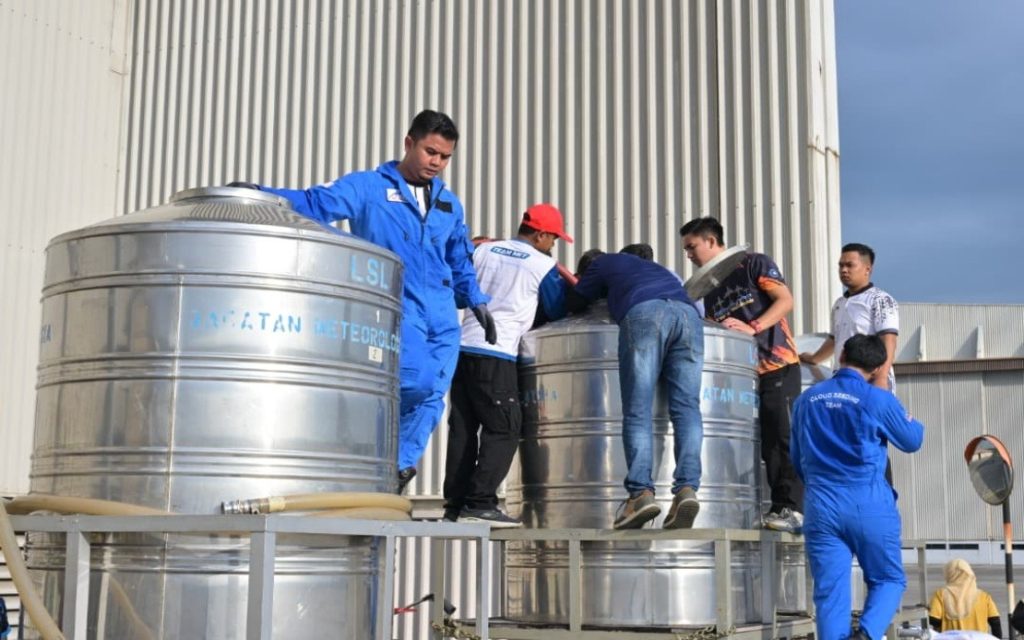
He said OPA uses salt water spraying techniques prepared in four tanks with a total capacity of 6,000 litres and the operational process takes between eight and nine hours starting with the preparation of the solution, crew briefing, flight to the target location and spraying at an altitude of between 5,200 and 7,000 feet.

He said the effects of water droplet formation in the clouds could be seen as early as half an hour to an hour after spraying and were expected to fall as rain within one to two hours with a success rate of 80 percent.

However, Ambun admitted that the operation faced major challenges, especially in identifying suitable clouds during hot weather, as well as sudden changes in wind direction which could cause rain to stray from the target area.

He also dispelled confusion regarding the use of dangerous chemicals in the operation by emphasizing that the operation merely imitates the natural process of condensation of salt molecules from the sea to land and only uses normal saline solution.

“We just want to add the salt solution so that the rain will fall faster and in the target area. That’s it. It is not dangerous because the salt we use is the salt we eat every day,” he said.

— BERNAMA

Related News