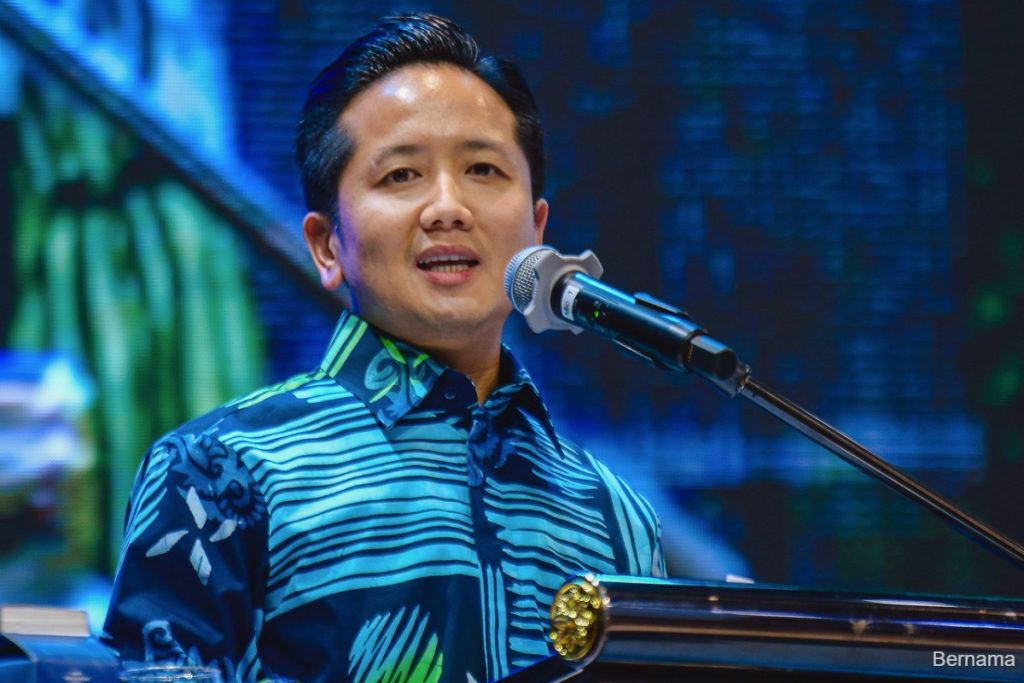
PETALING JAYA, April 21 (2026)– The government will review the implementation of the proposed carbon tax, taking into account the current economic and geopolitical crises, said Natural Resources and Environmental Sustainability Minister Datuk Seri Arthur Joseph Kurup.
He said the carbon tax, initially planned for introduction this year and targeted at selected industries such as steel, cement and construction, may be deferred to avoid placing additional burdens on industries and consumers amid current global uncertainties.
“We as a government have to be in touch with reality and also take into account the economic and geopolitical situation. We do not want to put any extra burden on industries or even onto the normal rakyat or the consumers at this time.
“So we may review the implementation of the carbon tax,” he told reporters after attending the opening of the Climate Change and Sustainability Conference 2026 at the M World Hotel here today.
Arthur said while the Natural Resources and Environmental Sustainability Ministry (NRES) is focused on establishing the framework for carbon trading, the carbon tax actually falls under the jurisdiction of the Finance Ministry.
Arthur said any decision on the implementation of the tax would require close coordination with the Finance Ministry.
“But at the same time, we would like to plead to the industry and also to society, don’t take this as an excuse for us to slow down our climate change agenda,” he said.
He noted that the volatility in fuel and energy prices reinforced the need for Malaysia to continue its transition towards a greener economy and the greater use of renewable energy.
“So whether in crisis or not, let’s not slack off or let’s not be too dependent on fossil fuels. Even during this time, we still need to move there. So it’s a matter of timing, rather than implementation,” he said..
Prime Minister Datuk Seri Anwar Ibrahim had said during the Budget 2025 speech that there were plans to introduce a carbon tax for the iron, steel and energy industries by 2026 as part of Malaysia’s efforts to strengthen climate action and support low-carbon economic growth to achieve its sustainability targets.
Meanwhile, he said the launch of the National Carbon Market Policy (NCMP), in conjunction with the conference, marked a major step in establishing the national framework for carbon emissions trading and supporting Malaysia’s broader climate commitments under the United Nations Framework Convention on Climate Change (UNFCCC) and the Paris Agreement.
He said the policy would provide the framework to ensure carbon credits are measurable, verifiable and backed by data integrity before complementary legislation, including the proposed National Climate Change Bill and other related laws, is introduced to provide enforceability to the carbon market ecosystem.
Arthur said the framework would also pave the way for a national carbon registry to facilitate measurement, pricing and future international carbon trading.
On Sabah and Sarawak’s separate carbon-related laws and policies, he said the federal government would focus on harmonisation to ensure state-level frameworks are aligned with national policies and international reporting obligations.
He also said a special committee would be set up to discuss coordination with the Sarawak government, while feedback from both Borneo states had been positive.
“Ultimately, it is the central government has to report our international commitments to the UNFCCC and Paris Agreement, so there must be synchronisation,” he added.
— BERNAMA