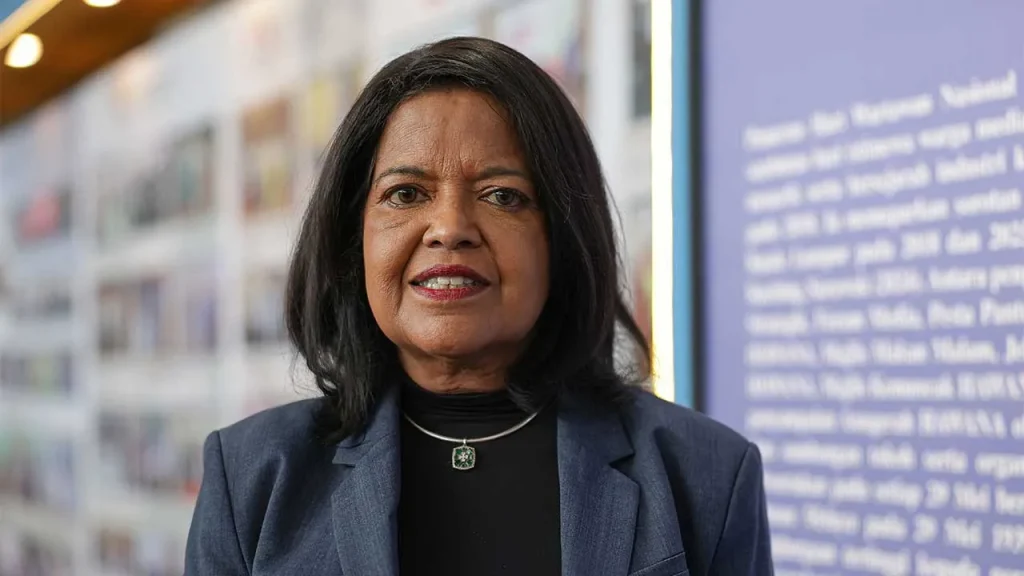
BUTTERWORTH, JUNE 20 -- Newly appointed Malaysian Media Council (MMC) chairman Tan Sri Nallini Pathmanathan believes that her decades of experience in the judiciary can help the council build credibility, defend freedom and gain the people's trust. Responding to a question about the selection of a former judge to lead the media self-regulatory body, Nallini said the effectiveness of the council did not depend on power, but rather on its ability to gain confidence through the principles of justice and independence. "I am not a journalist. I have never run a newsroom, determined front pages or worked to deadlines to complete an assignment for the news desk," he said at a Media Dialogue Session with Communications Minister Datuk Fahmi Fadzil, here, today. However, the former Federal Court Judge said his experience in the judicial institution equipped him with the skills to defend the independence of the council, ensure a fair process and maintain public confidence in every decision made. "The main thing I can bring to this table is justice between parties who have no vested interest, decided based on evidence and explained openly with reasonable reasons," he said. Nallini said the Malaysian Media Council Act itself clearly stipulates that its chairman must be independent of political influence, the civil service and the legislature, thus reflecting the need for a neutral figure who is able to gain the trust of all stakeholders. He said that while editors and journalists remain experts in reporting and newsroom operations, the council's role is to strengthen the media ecosystem through authoritative standards, effective complaints mechanisms and fair dispute resolution. Commenting on the direction of the MMC, Nallini said that among his main priorities was to ensure that the council's basic structure was built based on the principles of justice and accountability. “My priority is on quality and fairness in our own processes, including our code of ethics, complaints mechanisms and how we reach and explain decisions. "These early months are actually the phase of building the constitution of this institution. If we can lay the right foundation such as fundamental justice, balanced considerations and reasons that can be scrutinized, the position of this council will be built on its own," he said. He said the second principle that needs to be applied is that independent media must also be responsible, while responsible media must be protected from pressure, harassment, misuse of names and manipulation. "Freedom and responsibility are not two opposing things, but rather complement each other in building trust," he said. In this regard, Nallini said the MMC has identified three immediate priorities, namely establishing a fair and efficient complaints and adjudication framework, expanding membership in the industry, and addressing new challenges including fake content and the misuse of artificial intelligence (AI). "This council will only benefit the government, industry and society as long as it is not owned by any party." "This kind of freedom cannot be declared just through speech, but must be proven through every decision and our willingness to differ from any party. That is the standard we want to uphold," he said. At the same time, he stressed that the council's complaints mechanism should not be used as a tool to silence journalists because courageous reporting, challenging authorities and raising difficult questions are not problems that need to be fixed, but rather an important role of the independent media. "This council will uphold standards, but we will always ensure that efforts to uphold those standards are not abused to the point of hindering journalism, which is so necessary in a democracy," he said. Also present at the dialogue session held in conjunction with the celebration of National Journalists' Day (HAWANA) 2026 were the Secretary-General of the Ministry of Communications Datuk Abdul Halim Hamzah and Deputy Secretary-General (Strategic Communications and Creative Industries) Datuk Bahria Mohd Tamil. Also present were Bernama Chairman Datuk Seri Wong Chun Wai; Bernama Chief Executive Officer and Chairman of the HAWANA 2026 Working Committee Datin Paduka Nur-ul Afida Kamaludin; Bernama Editor-in-Chief Arul Rajoo Durar Raj, as well as senior management of local media organisations. -- BERNAMA

Judicial experience helps strengthen MMC’s credibility – Nallini

BUTTERWORTH, JUNE 20 — Newly appointed Malaysian Media Council (MMC) chairman Tan Sri Nallini Pathmanathan believes that her decades of experience in the judiciary can help the council build credibility, defend freedom and gain the people’s trust.

Responding to a question about the selection of a former judge to lead the media self-regulatory body, Nallini said the effectiveness of the council did not depend on power, but rather on its ability to gain confidence through the principles of justice and independence.

“I am not a journalist. I have never run a newsroom, determined front pages or worked to deadlines to complete an assignment for the news desk,” he said at a Media Dialogue Session with Communications Minister Datuk Fahmi Fadzil, here, today.

However, the former Federal Court Judge said his experience in the judicial institution equipped him with the skills to defend the independence of the council, ensure a fair process and maintain public confidence in every decision made.

“The main thing I can bring to this table is justice between parties who have no vested interest, decided based on evidence and explained openly with reasonable reasons,” he said.

Nallini said the Malaysian Media Council Act itself clearly stipulates that its chairman must be independent of political influence, the civil service and the legislature, thus reflecting the need for a neutral figure who is able to gain the trust of all stakeholders.

He said that while editors and journalists remain experts in reporting and newsroom operations, the council’s role is to strengthen the media ecosystem through authoritative standards, effective complaints mechanisms and fair dispute resolution.

Commenting on the direction of the MMC, Nallini said that among his main priorities was to ensure that the council’s basic structure was built based on the principles of justice and accountability.

“My priority is on quality and fairness in our own processes, including our code of ethics, complaints mechanisms and how we reach and explain decisions.

“These early months are actually the phase of building the constitution of this institution. If we can lay the right foundation such as fundamental justice, balanced considerations and reasons that can be scrutinized, the position of this council will be built on its own,” he said.

He said the second principle that needs to be applied is that independent media must also be responsible, while responsible media must be protected from pressure, harassment, misuse of names and manipulation.

“Freedom and responsibility are not two opposing things, but rather complement each other in building trust,” he said.

In this regard, Nallini said the MMC has identified three immediate priorities, namely establishing a fair and efficient complaints and adjudication framework, expanding membership in the industry, and addressing new challenges including fake content and the misuse of artificial intelligence (AI).

“This council will only benefit the government, industry and society as long as it is not owned by any party.”

“This kind of freedom cannot be declared just through speech, but must be proven through every decision and our willingness to differ from any party. That is the standard we want to uphold,” he said.

At the same time, he stressed that the council’s complaints mechanism should not be used as a tool to silence journalists because courageous reporting, challenging authorities and raising difficult questions are not problems that need to be fixed, but rather an important role of the independent media.

“This council will uphold standards, but we will always ensure that efforts to uphold those standards are not abused to the point of hindering journalism, which is so necessary in a democracy,” he said.

Also present at the dialogue session held in conjunction with the celebration of National Journalists’ Day (HAWANA) 2026 were the Secretary-General of the Ministry of Communications Datuk Abdul Halim Hamzah and Deputy Secretary-General (Strategic Communications and Creative Industries) Datuk Bahria Mohd Tamil.

Also present were Bernama Chairman Datuk Seri Wong Chun Wai; Bernama Chief Executive Officer and Chairman of the HAWANA 2026 Working Committee Datin Paduka Nur-ul Afida Kamaludin; Bernama Editor-in-Chief Arul Rajoo Durar Raj, as well as senior management of local media organisations.

— BERNAMA

Related News