
Korea Deep Learning Secures Back-to-Back Global AI Benchmark Wins Over Big Tech
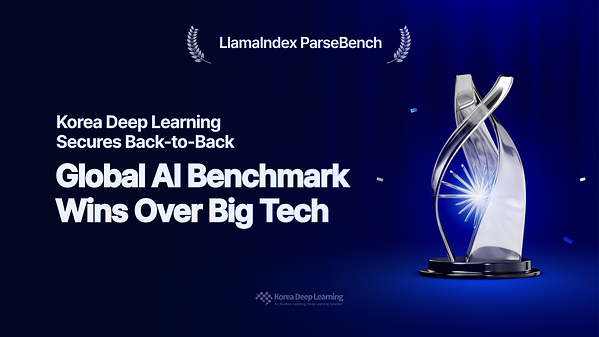
SEOUL, South Korea, June 22 -- Korea Deep Learning, a pioneer in enterprise-grade Document AI and vision intelligence solutions, today announced that its proprietary Document AI has secured the #1 overall ranking on ParseBench, a premier global document parsing benchmark organized by LlamaIndex.     ParseBench evaluates AI models on their ability to read, structure, and extract information from approximately 2,000 pages of complex, real-world enterprise documents across finance, insurance, and government sectors. In the latest evaluation, Korea Deep Learning ranked #1 overall in the VLM category with a score of 76.4, ahead of the next-highest-scoring models (75.0 and 67.8). The company also secured the top spot in Visual Grounding with a score of 78.8, establishing a commanding 19-point lead over the next-highest-scoring model (59.8). The win was driven by KDL-Frontier-Parser-nano, a 1.2-billion-parameter single model. Despite its compact size, it delivered superior accuracy against massive Big Tech systems at a fraction of the operational cost, proving that specialized AI tailored for business workflows can outperform broad, general-purpose LLMs. Its core edge lies in Korea Deep Learning's Near-Zero Hallucination technology, which simultaneously analyzes layout, field relationships, and spatial positioning to minimize error rates and extract data with context-aware precision. Trained on over 400 million images and documents, Korea Deep Learning's solutions support secure on-premise and SaaS deployments. Validated across major enterprise and public sectors, the technology powers administrative data restructuring for the Gyeonggi Provincial Government and serves over 80 major corporations, including Hyundai Capital and LG CNS—slashing document-processing times by up to 96%. Today's ParseBench victory builds on a consecutive string of global milestones. In March 2026, the company's proprietary Vision-Language Model, KDL Frontier, clinched the #1 spot in the English category of OCRBench v2 with a score of 68.1, outperforming other leading models. In recognition of this sustained technological leadership, Forbes Asia officially named CEO Jihyun Kim to its prestigious 2026 '30 Under 30' list in the Consumer & Enterprise Technology category last month. "Our strategy has always been to build specialized AI that decodes complex document structures as intuitively as a human, rather than focusing on massive LLMs," said Jihyun Kim, CEO of Korea Deep Learning. "This milestone validates our architecture as the most practical solution for the 'AI Agent' era, enabling autonomous decision-making and total workflow automation." Backed by an $8 million (KRW 12 billion) Series A funding round secured in December 2025 and a strategic partnership with NVIDIA, Korea Deep Learning is aggressively accelerating its global expansion into international enterprise markets. About Korea Deep Learning Founded in 2019, Korea Deep Learning is a premier vision intelligence and Document AI company developing enterprise-grade AI agents that automate document-based workflows. Its proprietary DEEP Agent platform combines advanced OCR, document parsing, and vision-language models to help organizations seamlessly extract, structure, and act on information from complex documents, images, and visual data. -- PRNewswire -- Source: Korea Deep Learning    

SEOUL, South Korea, June 22 — Korea Deep Learning, a pioneer in enterprise-grade Document AI and vision intelligence solutions, today announced that its proprietary Document AI has secured the #1 overall ranking on ParseBench, a premier global document parsing benchmark organized by LlamaIndex. ParseBench evaluates AI models on their ability to read, structure, and extract information from […]

S. Korea To Test AI-based Smart City Tech In Southeast Asia
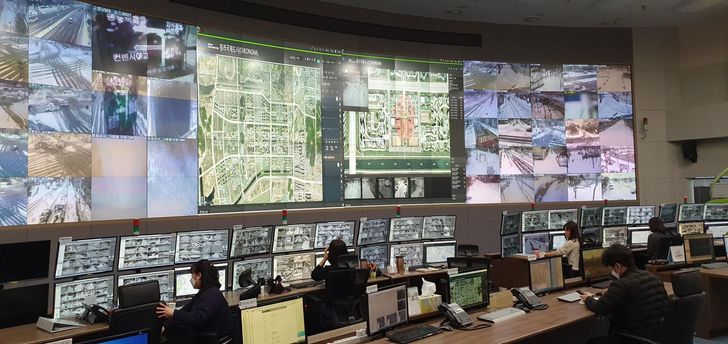
SEOUL, April 13 (Bernama-Yonhap) -- South Korea will carry out pilot projects to test smart city technologies based on artificial intelligence (AI) in five Southeast Asian countries, including Malaysia, aimed at helping address urban challenges and support domestic firms' global expansions, the land ministry said Monday. According to Yonhap News Agency, the ministry said it has selected six projects to be carried out in five countries under its 2026 K-City Network programme, an initiative that supports the application of domestic smart city projects. In Brunei, an AI-based smart city platform will be tested to improve water management and disaster response, while a smart traffic management system will help optimise traffic signals in Bacoor of the Philippines. Projects in Vietnam will help introduce on-demand transport services in Ho Chi Minh City and deploy AI-based smart intersection control systems in Can Tho to improve traffic flow. Additional projects include implementing a safety management solution for ageing buildings in Surin, Thailand, and deploying a traffic management system in Penang, Malaysia, to detect accidents and congestion. The ministry said the programme is expected to help validate the effectiveness of Korean smart technologies in overseas markets and lead to follow-up exports and investment opportunities.

SEOUL, April 13 (Bernama-Yonhap) — South Korea will carry out pilot projects to test smart city technologies based on artificial intelligence (AI) in five Southeast Asian countries, including Malaysia, aimed at helping address urban challenges and support domestic firms’ global expansions, the land ministry said Monday. According to Yonhap News Agency, the ministry said it […]