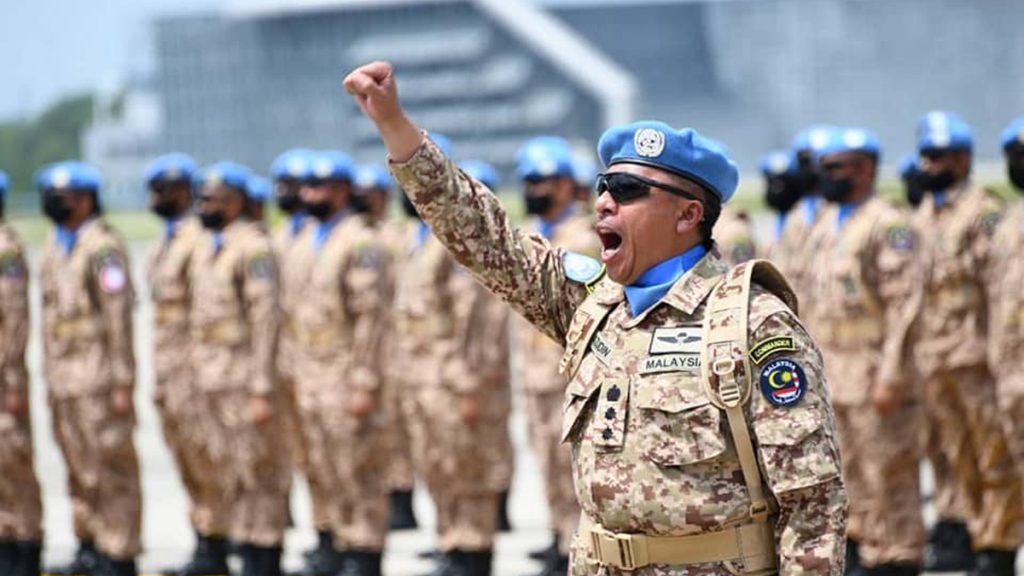
KUALA LUMPUR — Malaysia should maintain its commitment to the peacekeeping mission in southern Lebanon even though tensions in the region are reportedly escalating following the conflict between Israel and Hezbollah.
Geostrategy expert Prof Dr Azmi Hassan said in the context of conflicts in West Asia, the presence of peacekeepers, including the Malaysian Battalion (MALBATT) under the United Nations Interim Force in Lebanon (UNIFIL), acts as a deterrent to reduce the risk of continued attacks.
He said for example, if there is a ceasefire decision, the presence of peacekeepers is usually necessary because if the warring parties, including the United States, Israel and Iran, agree, peacekeepers will be deployed at the border or conflict area.
“Their presence acts as a deterrent to prevent any further attacks, including in strategic locations such as Tehran city, Iran’s nuclear plant and oil reserves.
“In this way, UN peacekeepers help curb the risk of renewed attacks and maintain stability in critical areas,” he told Bernama recently.
He said Malaysia had previously also played an active role in peacekeeping missions in several conflict areas including Lebanon, Mindanao and the Democratic Republic of Congo under the mandate of the UN Security Council.
“Malaysia is among the leading countries in contributing personnel and military equipment to peacekeeping missions under the UN mandate,” he said.
Azmi said the participation of MALBATT was also important to show the country’s commitment to the international peacekeeping mandate.
“It is important for Malaysia to maintain its commitment in Lebanon because it gives the impression that even though we are a small country, Malaysia can be relied upon to provide UN-mandated peacekeeping forces,” he said.
He said the tense situation in the UNIFIL operation area was not new because Malaysian peacekeepers had previously faced critical situations but were still able to continue their mission.
He said any decision to withdraw MALBATT or change the deployment of peacekeepers could not be made unilaterally by Malaysia because the mandate of the operation was under the UN Security Council.
“In this case, the decision to withdraw or exit from southern Lebanon was entirely in the hands of the UN Security Council and not a decision that Malaysia could make alone,” he said.
Meanwhile, Universiti Utara Malaysia Deputy Vice-Chancellor (Academic and International) Prof Dr Mohd Azizuddin Mohd Sani said the level of security risk to peacekeeping personnel including MALBATT had indeed increased when the conflict between Israel and Hezbollah was at its peak.
However, he said both sides in the conflict usually know the location of the UN peacekeeping forces, which consist of members from various countries.
He said UNIFIL’s main role in the border area is to act as a buffer zone to prevent direct clashes between the two sides, as well as channel humanitarian aid to the population affected by the conflict.
“These peacekeeping forces act as a buffer in the border area to prevent the conflict from degenerating into poverty, as well as helping the population affected in the area.
“However, in situations of armed conflict such as the use of rockets or drones, there is a possibility that peacekeeping forces are also exposed to the risk of being attacked even though they are not the direct targets,” he said.
Mohd Azizuddin said that so far the situation is still considered under control as long as there is no land incursion across the border, but peacekeepers must always be vigilant of current developments.
Previously, the MALBATT 850-13 team, which is currently carrying out a peacekeeping mission under UNIFIL in southern Lebanon, announced that the level of readiness of its members has been further enhanced, covering aspects of security, operational readiness, logistics and coordination with stakeholders.
In a statement on Facebook, the team announced that each member is trained to act professionally and disciplined in any situation in line with the principles of peacekeeping operations under the UNIFIL banner.
According to international media reports, Israeli airstrikes on Lebanon since March 2 have claimed hundreds of lives, following cross-border attacks with Hezbollah.
In a related development, the UN High Commissioner for Refugees (UNHCR) reported that nearly 700,000 people have been displaced across Lebanon in more than a week following the escalating conflict.
— BERNAMA