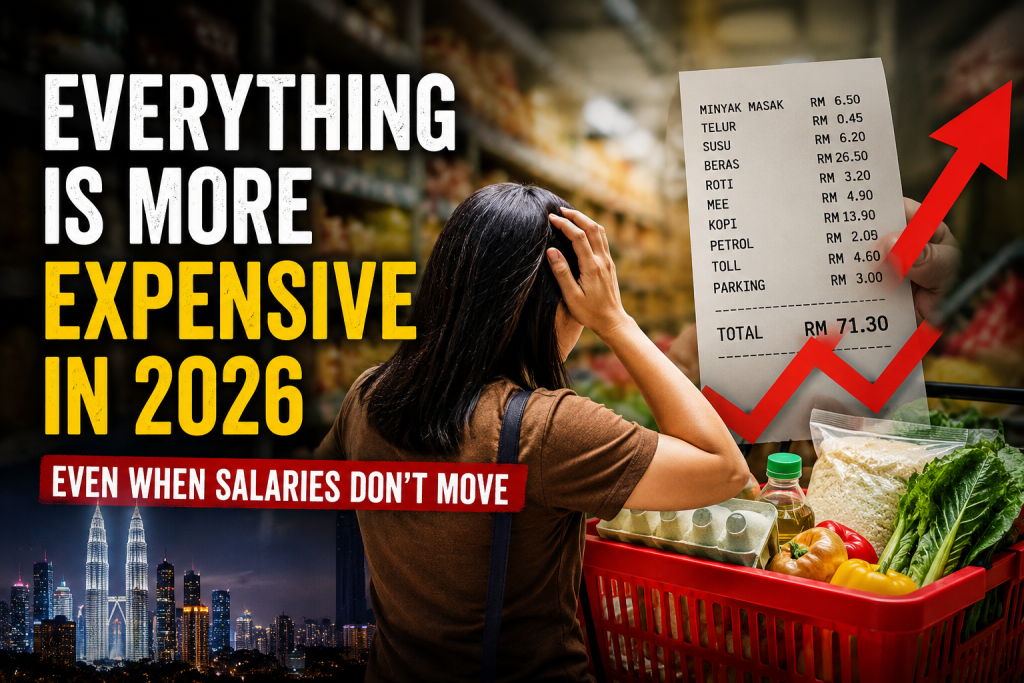
There is a quiet frustration many Malaysians share today, often spoken at mamak tables, during lunch breaks, or in late-night conversations with friends: “Everything is getting more expensive, but my salary feels the same.”
It is not just a feeling anymore. For many households across Malaysia—whether in Kuala Lumpur, Selangor, Johor, or smaller towns—the cost of daily life has gradually shifted from manageable to constantly stretching the ringgit thinner than before.
But what exactly is happening?
The Invisible Inflation of Everyday Life
Inflation is not new. Economists have always reminded us that prices rise over time. But what Malaysians are experiencing now feels different—it is not just the price of luxury goods or big-ticket items.
It is the small, everyday things.
A plate of nasi goreng that once cost RM6.50 is now RM8 or RM9. A simple café drink that used to be RM10 is now RM13 or RM15. Parking fees, tolls, groceries, even basic household items—all seem to have quietly adjusted upward.
Individually, these increases feel minor. But collectively, they reshape monthly budgets in a very real way.
For lower- and middle-income households, the difference is no longer about “saving a little less”—it is about choosing what to cut.

Wages That Don’t Keep Up
While prices have moved steadily upward, wages in many sectors have not kept pace at the same speed.
Yes, Malaysia has seen minimum wage adjustments and salary revisions in some industries. But for many workers—especially those in entry-level jobs, gig work, or small and medium enterprises—the increase has not matched the real cost of living in urban areas.
This creates a quiet imbalance: people are working just as hard, sometimes harder, but feeling like they are falling behind.
It is not just about numbers on a payslip. It is about the psychological pressure of effort not translating into stability.
The Middle-Class Squeeze Is Real
Perhaps the most affected group today is the urban middle class.
They earn “too much” to qualify for assistance, but not enough to comfortably absorb rising costs. Housing loans, car payments, childcare, education fees, and daily expenses form a tight monthly cycle that leaves little room for savings.
Even small disruptions—such as a medical emergency or unexpected repair—can throw financial planning off balance.
This is where many Malaysians quietly feel stuck: not struggling enough to be considered in crisis, but not comfortable enough to feel secure.
Lifestyle Changes Are Masking the Problem
One interesting shift is how Malaysians are adapting. Instead of large visible protests about cost of living, the response has been subtle and behavioural.
People are:
- Eating out less often, or choosing cheaper spots
- Switching from cafés back to home-brewed drinks
- Delaying major purchases
- Relying more on online deals and second-hand markets
- Taking on side income or gig work
On the surface, life goes on normally. But underneath, spending habits are being reshaped by necessity, not preference.
Why It Feels Worse Today
Part of the emotional weight comes from comparison.
Social media constantly shows a lifestyle that feels increasingly out of reach—trips, cafés, gadgets, and “soft life” aesthetics. At the same time, real income growth feels slow.
This gap between expectation and reality creates frustration that is not just financial, but emotional.
People are not only asking “Can I afford this?” but also “Why does everyone else seem able to?”

Is This the New Normal?
Malaysia is not alone in facing cost pressures. Many countries are going through similar cycles of inflation, housing challenges, and wage stagnation.
But locally, the concern is whether this gap between income and living costs is becoming structural rather than temporary.
If wages do not adjust in step with real-world expenses, then affordability will slowly redefine what “middle class life” even means in Malaysia.
A Quiet Question for the Future
Ultimately, this is not just an economic issue—it is a quality-of-life issue.
How long can households continue adjusting before something has to give? Will wages catch up, or will expectations simply continue to shrink?
For now, Malaysians continue adapting in quiet ways. They budget more carefully, choose more selectively, and stretch each ringgit further than before.
But the underlying question remains unresolved:
If everything is getting more expensive, what exactly are we working so hard for?
— MINUTESMY / SUGAN BALAN