A journey along China’s ancient Silk Road offers travellers an opportunity to explore the country’s rich history, diverse cultures, spectacular landscapes and distinctive regional cuisines.
Stretching across more than 4,200 kilometres, the historic trade route passes through deserts, mountains, valleys and oases, connecting destinations that once served as important centres of trade and cultural exchange.
The journey began with a flight from Shanghai to Kashgar, also known locally as Kashi, in western China’s Xinjiang region. From there, the travellers made a side trip to Tashkurgan before continuing east through Kuche, Turpan, Urumqi, Jiayuguan, Dunhuang, Zhangye and Lanzhou, eventually reaching Xi’an.
Travelling independently after China’s October Golden Week allowed them to avoid peak-season crowds, secure affordable accommodation and enjoy greater flexibility in exploring local attractions and autumn scenery.
In Kashgar, historic landmarks such as the Id Kah Mosque, Abakh Khoja Mausoleum and traditional Gaotai residences offered insights into the city’s longstanding role as a meeting point between China and Central Asia. The Sunday Livestock Bazaar and night markets also provided a glimpse into local life, with stalls selling spices, fresh produce and street food.
The journey to Tashkurgan revealed snow-covered mountains, glacial lakes and expansive grasslands across the Pamir region. Highlights included Baisha Lake, Kala Kule Lake and the winding Panlong Highway, known for its dramatic curves across the high-altitude landscape.
Further east, Kuche showcased its Islamic heritage through the Grand Mosque, while nearby attractions included the Kizil Cave Temple Complex, the Tianshan Grand Canyon and the ruins of Subashi Ancient City.
In Turpan, a homestay in Grape Valley offered an opportunity to experience local hospitality and sample the region’s grapes and raisins. Other attractions included Sugong Tower, Flaming Mountain, the Bezeklik Thousand Buddha Caves, Tuyugou village and the ancient ruins of Jiaohe.
Urumqi, the capital of Xinjiang, presented a contrast between modern urban life and cultural heritage, with attractions such as the Xinjiang Regional Museum and Tianchi Lake.
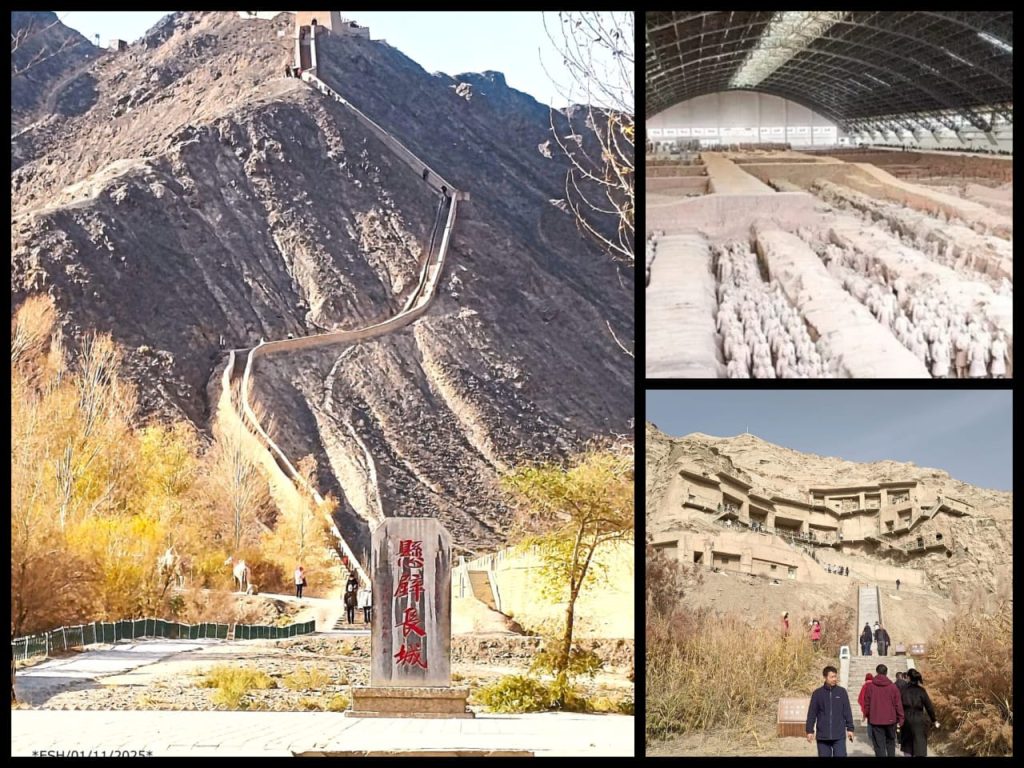
The journey continued to Jiayuguan, a historic frontier town associated with the Great Wall of China. Jiayuguan Fort, the Hanging Great Wall and the First Beacon Tower illustrated the region’s strategic importance in safeguarding the ancient trade routes.
In Dunhuang, the Mogao Grottoes, Yangguan and Yumen Pass offered a closer look at the Silk Road’s historical and cultural significance. The Yardang National Geopark provided striking desert scenery, while Crescent Moon Lake, surrounded by sand dunes, created a memorable setting for a sunset walk.
Zhangye added another dimension to the journey through the Giant Buddha Temple and the Mati Temple grotto complex. Meanwhile, Lanzhou offered riverside views along the Yellow River, a walk across Zhongshan Bridge and a visit to the Bingling Temple grottoes, which can be reached by boat.
The final destination, Xi’an, brought the journey to one of China’s most historically significant cities, with more than 3,000 years of history. Its Bell and Drum Towers, Muslim Quarter, Great Mosque and Gao Family Mansion reflected the city’s diverse cultural influences.
No visit to Xi’an would be complete without exploring the Terracotta Warriors, which guard the mausoleum of Qin Shi Huang, China’s first emperor, as well as the wider mausoleum complex and Huaqing Palace.
Food remained a central part of the experience throughout the journey. In Kashgar, regional favourites included laghman noodles, pilaf, dapanji chicken, lamb kebabs, samsa pastries, apricot juice and Hami melons. A yak hotpot in Tashkurgan provided another memorable culinary experience.
Turpan was known for its sweet grapes and raisins, while Lanzhou’s signature beef noodles stood out as a must-try dish. In Xi’an, travellers sampled local specialities including roujiamo flatbread sandwiches, yangrou paomo bread-and-lamb soup, biangbiang noodles, liangpi cold noodles and a variety of dumplings.
Beyond its historical landmarks and culinary discoveries, the journey highlighted the enduring cultural connections forged along the Silk Road. From mountain peaks and desert landscapes to ancient religious sites and lively markets, each destination offered a glimpse into China’s past and the hospitality of its people.
The experience demonstrated how travelling along the historic route remains a meaningful way to discover the country’s cultural diversity, regional traditions and rich gastronomic heritage.
Source: Adapted from the original travel feature.
-AWANI