KUALA LUMPUR: The newly appointed Saudi Arabian Ambassador to Malaysia, who began working in the country in January, recently shared his initial views and priorities in an exclusive interview with the Malaysian National News Agency (Bernama). In the interview, Osamah Dakhdel Al Ahmadi commented on the continued progress of Malaysia-Saudi Arabia relations which is strengthened by strong political will as well as growing economic cooperation, particularly in line with Saudi Arabia's Vision 2030. He reaffirmed the Saudi Arabian government's continued commitment to improving services to pilgrims, including those from Malaysia, in addition to outlining the country's diplomatic approach to regional developments by emphasizing stability, restraint and dialogue. Personally, he also expressed his appreciation for Malaysia's culinary diversity, especially beef jerky which is one of his favorite dishes. Below is the full transcript of the interview with Bernama. Malaysia-Saudi Arabia economic relations: How do you assess the current business and investment relations between Malaysia and Saudi Arabia? Are there any new sectors or opportunities that should be explored by both sides? Saudi Arabia-Malaysia relations are witnessing rapid substantive development, reflecting the determination of the leadership of both countries to elevate relations to a broader and stronger level. The most recent exchange of official visits, the visit of Prime Minister Datuk Seri Anwar Ibrahim in 2023-2024 and the Yang di-Pertuan Agong, Sultan Ibrahim to Saudi Arabia in November 2025, has contributed to creating stronger and deeper relations. During the visit, emphasis was placed on strengthening cooperation in priority sectors by leveraging investment opportunities offered through Saudi Arabia's Vision 2030 and Malaysia's Vision MADANI, building on the achievements of the Saudi-Malaysia Coordination Council (SMCC), as well as developing partnerships in various areas that serve the interests of both countries. The two brotherly countries enjoy strong relations and growing political and economic ties, and are committed to continuing this positive path that reflects a shared desire to expand areas of cooperation, enhance mutual trust, and propel relations to broader horizons in the coming phase. Economic cooperation between Saudi Arabia and Malaysia offers broad and growing opportunities, particularly through the conducive environment for quality projects and value-added investments provided by Saudi Arabia's Vision 2030. There is growing interest in developing partnerships in the areas of investment, renewable energy, industry, construction, tourism, logistics and modern technology - sectors in which companies in both countries have their own expertise and which represent priorities in the economic transformation process. This ambition is not limited to increasing the volume of trade exchanges, but also includes building sustainable partnerships based on the transfer of expertise, stimulating joint investments and developing joint projects that benefit both countries. Hajj Preparations: With the Hajj season approaching, how are preparations progressing this year? What assurances can you offer pilgrims, especially regarding safety, logistics and the overall experience? Serving pilgrims is a deep-rooted mission and a primary responsibility of Saudi Arabia, which receives constant attention from its leadership. It is not just a seasonal organizational aspect, but rather an integral part of a comprehensive vision that aims to facilitate the Hajj and Umrah pilgrimage and improve the quality of services provided to them at every stage. Saudi Arabia continues to improve services, organizational infrastructure and technology to provide a more convenient, reassuring and comfortable environment for pilgrims from all over the world, including Malaysia. Saudi Arabia launched the "Makkah Route" initiative which allows pilgrims to complete entry procedures at their respective country's airports before proceeding to their accommodation. The initiative also involves Malaysia, thus reflecting its direct impact in facilitating the travel of Malaysian pilgrims. On the situation in West Asia: How would you describe the current geopolitical landscape in West Asia and what is Saudi Arabia's stance on the ongoing conflict? To what extent do these developments affect Saudi Arabia? Saudi Arabia has a strong vision based on supporting stability, preventing the escalation of crises, and prioritizing political and diplomatic solutions. This stems from the conviction that the security and prosperity of the region can only be achieved through dialogue, respect for national sovereignty, and addressing crises at their root causes, thereby protecting the interests of their people and preventing further escalation of tensions. Saudi Arabia's position is clear and firm. Saudi Arabia condemns Iran's attacks targeting Saudi Arabia, the Gulf States and Jordan, considering them an unacceptable violation of national sovereignty and a direct threat to the security and stability of the region. Saudi Arabia completely rejects any excuses that attempt to justify this attack. Saudi Arabia has officially stated that it will not allow its airspace or territory to be used to attack Iran. Therefore, this allegation is completely unacceptable. Furthermore, Saudi Arabia continues to exercise complete discretion and self-control. Saudi Arabia continues to work in coordination with other countries to support efforts to ease tensions, urge the implementation of a ceasefire, and restore regional stability. These unjustified attacks target countries not involved in the war, attacking civilian infrastructure, energy facilities and residential areas, which directly affects the interests of the people and the population. Saudi Arabia calls for an immediate halt to the attacks, an end to the escalation of tensions, and for international law and the principles of good neighborliness to be observed in order to preserve the security and stability of the region. Energy and global markets: Given the changing dynamics of global energy, how does Saudi Arabia balance its role as a major oil producer with the global shift towards renewable energy? Saudi Arabia addresses the issues of energy market stability and the protection of important waterways in accordance with international law. It stressed the importance of the security of maritime routes and freedom of navigation, including the Strait of Hormuz and the Strait of Bab el-Mandeb. Any threat to these waterways not only affects the global economy and international energy security, but also affects the movement of trade and essential goods, including food supplies, which directly impact the needs of the country and its people. From this perspective, Saudi Arabia's East-West pipeline stands out as an important strategic route for enhancing global supply stability, especially given the escalating military confrontation and its direct impact on maritime traffic in the Strait of Hormuz. This pipeline gives Saudi Arabia significant flexibility in transporting supplies to the Red Sea coast via safe alternative routes, thus ensuring continuity and reliability of supply and reducing the impact of regional tensions. Crisis response and humanitarian efforts: How does the Government of Saudi Arabia contribute to humanitarian assistance and reconstruction efforts in areas affected by conflict? Saudi Arabia plays a leading role through its unwavering commitment to its responsibilities. Humanitarian assistance to people affected by war, natural disasters, and humanitarian crises is provided by the King Salman Humanitarian Aid and Relief Center (KSRelief), which implements impactful projects and programs that have alleviated the suffering of millions of people in need around the world. The center has implemented over 4,000 humanitarian and emergency assistance projects in 113 countries at a cost of over US$8 billion across a variety of critical sectors. These projects have contributed to providing immediate assistance to those affected, in addition to supporting development programs that promote stability and improve the quality of life in beneficiary communities. Saudi Arabia ranks second globally and first among Arab countries in providing humanitarian aid and relief by 2025. In addition, Saudi Arabia continues its humanitarian support for the Palestinian people through KSRelief. The center's official data shows that 78 aircraft and eight ships have been dispatched carrying more than 7,706 tons of aid, in addition to 914 aid trucks, 20 ambulances, and aid agreements worth more than US$90 million, reflecting a combination of political stance with direct and planned humanitarian action. Saudi Arabia has consistently emphasized in its official stance and statements its clear rejection of the Israeli aggression and continued violations against the Palestinian people. The country is also actively engaging diplomatically with its regional and international partners to support a more effective stance on the development. Among the most recent examples is the joint stance of the Foreign Minister of Saudi Arabia and several Arab and Islamic countries in rejecting the decision passed by the Knesset (Israeli Parliament) on the execution of Palestinian prisoners, considering it a dangerous escalation that undermines opportunities for stability. Saudi Arabia continues its active political role, in collaboration with France, in leading international efforts to implement a two-state solution. -- BERNAMA

New Saudi ambassador stresses strengthening bilateral ties, Hajj commitment, regional outlook

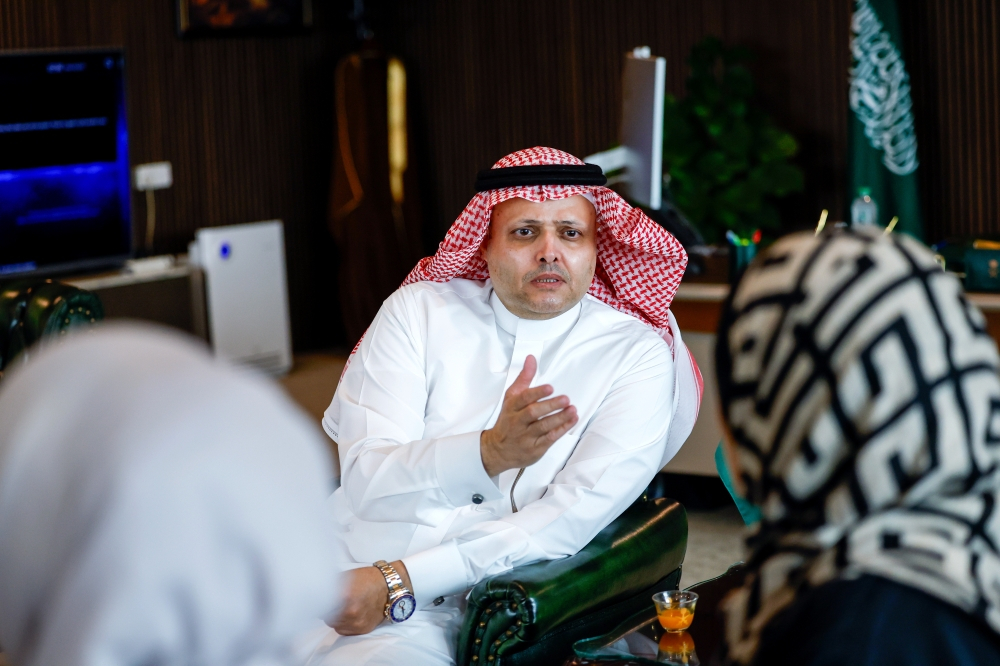
KUALA LUMPUR: The newly appointed Saudi Arabian Ambassador to Malaysia, who began working in the country in January, recently shared his initial views and priorities in an exclusive interview with the Malaysian National News Agency (Bernama).

In the interview, Osamah Dakhdel Al Ahmadi commented on the continued progress of Malaysia-Saudi Arabia relations which is strengthened by strong political will as well as growing economic cooperation, particularly in line with Saudi Arabia’s Vision 2030.

He reaffirmed the Saudi Arabian government’s continued commitment to improving services to pilgrims, including those from Malaysia, in addition to outlining the country’s diplomatic approach to regional developments by emphasizing stability, restraint and dialogue.

Personally, he also expressed his appreciation for Malaysia’s culinary diversity, especially beef jerky which is one of his favorite dishes.

Below is the full transcript of the interview with Bernama.

Malaysia-Saudi Arabia economic relations: How do you assess the current business and investment relations between Malaysia and Saudi Arabia? Are there any new sectors or opportunities that should be explored by both sides?

Saudi Arabia-Malaysia relations are witnessing rapid substantive development, reflecting the determination of the leadership of both countries to elevate relations to a broader and stronger level.

The most recent exchange of official visits, the visit of Prime Minister Datuk Seri Anwar Ibrahim in 2023-2024 and the Yang di-Pertuan Agong, Sultan Ibrahim to Saudi Arabia in November 2025, has contributed to creating stronger and deeper relations.

During the visit, emphasis was placed on strengthening cooperation in priority sectors by leveraging investment opportunities offered through Saudi Arabia’s Vision 2030 and Malaysia’s Vision MADANI, building on the achievements of the Saudi-Malaysia Coordination Council (SMCC), as well as developing partnerships in various areas that serve the interests of both countries.

The two brotherly countries enjoy strong relations and growing political and economic ties, and are committed to continuing this positive path that reflects a shared desire to expand areas of cooperation, enhance mutual trust, and propel relations to broader horizons in the coming phase.

Economic cooperation between Saudi Arabia and Malaysia offers broad and growing opportunities, particularly through the conducive environment for quality projects and value-added investments provided by Saudi Arabia’s Vision 2030.

There is growing interest in developing partnerships in the areas of investment, renewable energy, industry, construction, tourism, logistics and modern technology – sectors in which companies in both countries have their own expertise and which represent priorities in the economic transformation process.

This ambition is not limited to increasing the volume of trade exchanges, but also includes building sustainable partnerships based on the transfer of expertise, stimulating joint investments and developing joint projects that benefit both countries.

Hajj Preparations: With the Hajj season approaching, how are preparations progressing this year? What assurances can you offer pilgrims, especially regarding safety, logistics and the overall experience?

Serving pilgrims is a deep-rooted mission and a primary responsibility of Saudi Arabia, which receives constant attention from its leadership. It is not just a seasonal organizational aspect, but rather an integral part of a comprehensive vision that aims to facilitate the Hajj and Umrah pilgrimage and improve the quality of services provided to them at every stage.

Saudi Arabia continues to improve services, organizational infrastructure and technology to provide a more convenient, reassuring and comfortable environment for pilgrims from all over the world, including Malaysia.

Saudi Arabia launched the “Makkah Route” initiative which allows pilgrims to complete entry procedures at their respective country’s airports before proceeding to their accommodation.

The initiative also involves Malaysia, thus reflecting its direct impact in facilitating the travel of Malaysian pilgrims.

On the situation in West Asia: How would you describe the current geopolitical landscape in West Asia and what is Saudi Arabia’s stance on the ongoing conflict? To what extent do these developments affect Saudi Arabia?

Saudi Arabia has a strong vision based on supporting stability, preventing the escalation of crises, and prioritizing political and diplomatic solutions.

This stems from the conviction that the security and prosperity of the region can only be achieved through dialogue, respect for national sovereignty, and addressing crises at their root causes, thereby protecting the interests of their people and preventing further escalation of tensions.

Saudi Arabia’s position is clear and firm. Saudi Arabia condemns Iran’s attacks targeting Saudi Arabia, the Gulf States and Jordan, considering them an unacceptable violation of national sovereignty and a direct threat to the security and stability of the region.

Saudi Arabia completely rejects any excuses that attempt to justify this attack.

Saudi Arabia has officially stated that it will not allow its airspace or territory to be used to attack Iran. Therefore, this allegation is completely unacceptable. Furthermore, Saudi Arabia continues to exercise complete discretion and self-control.

Saudi Arabia continues to work in coordination with other countries to support efforts to ease tensions, urge the implementation of a ceasefire, and restore regional stability.

These unjustified attacks target countries not involved in the war, attacking civilian infrastructure, energy facilities and residential areas, which directly affects the interests of the people and the population.

Saudi Arabia calls for an immediate halt to the attacks, an end to the escalation of tensions, and for international law and the principles of good neighborliness to be observed in order to preserve the security and stability of the region.

Energy and global markets: Given the changing dynamics of global energy, how does Saudi Arabia balance its role as a major oil producer with the global shift towards renewable energy?

Saudi Arabia addresses the issues of energy market stability and the protection of important waterways in accordance with international law.

It stressed the importance of the security of maritime routes and freedom of navigation, including the Strait of Hormuz and the Strait of Bab el-Mandeb.

Any threat to these waterways not only affects the global economy and international energy security, but also affects the movement of trade and essential goods, including food supplies, which directly impact the needs of the country and its people.

From this perspective, Saudi Arabia’s East-West pipeline stands out as an important strategic route for enhancing global supply stability, especially given the escalating military confrontation and its direct impact on maritime traffic in the Strait of Hormuz.

This pipeline gives Saudi Arabia significant flexibility in transporting supplies to the Red Sea coast via safe alternative routes, thus ensuring continuity and reliability of supply and reducing the impact of regional tensions.

Crisis response and humanitarian efforts: How does the Government of Saudi Arabia contribute to humanitarian assistance and reconstruction efforts in areas affected by conflict?

Saudi Arabia plays a leading role through its unwavering commitment to its responsibilities.

Humanitarian assistance to people affected by war, natural disasters, and humanitarian crises is provided by the King Salman Humanitarian Aid and Relief Center (KSRelief), which implements impactful projects and programs that have alleviated the suffering of millions of people in need around the world.

The center has implemented over 4,000 humanitarian and emergency assistance projects in 113 countries at a cost of over US$8 billion across a variety of critical sectors.

These projects have contributed to providing immediate assistance to those affected, in addition to supporting development programs that promote stability and improve the quality of life in beneficiary communities.

Saudi Arabia ranks second globally and first among Arab countries in providing humanitarian aid and relief by 2025.

In addition, Saudi Arabia continues its humanitarian support for the Palestinian people through KSRelief.

The center’s official data shows that 78 aircraft and eight ships have been dispatched carrying more than 7,706 tons of aid, in addition to 914 aid trucks, 20 ambulances, and aid agreements worth more than US$90 million, reflecting a combination of political stance with direct and planned humanitarian action.

Saudi Arabia has consistently emphasized in its official stance and statements its clear rejection of the Israeli aggression and continued violations against the Palestinian people.

The country is also actively engaging diplomatically with its regional and international partners to support a more effective stance on the development.

Among the most recent examples is the joint stance of the Foreign Minister of Saudi Arabia and several Arab and Islamic countries in rejecting the decision passed by the Knesset (Israeli Parliament) on the execution of Palestinian prisoners, considering it a dangerous escalation that undermines opportunities for stability.

Saudi Arabia continues its active political role, in collaboration with France, in leading international efforts to implement a two-state solution.

— BERNAMA

Related News