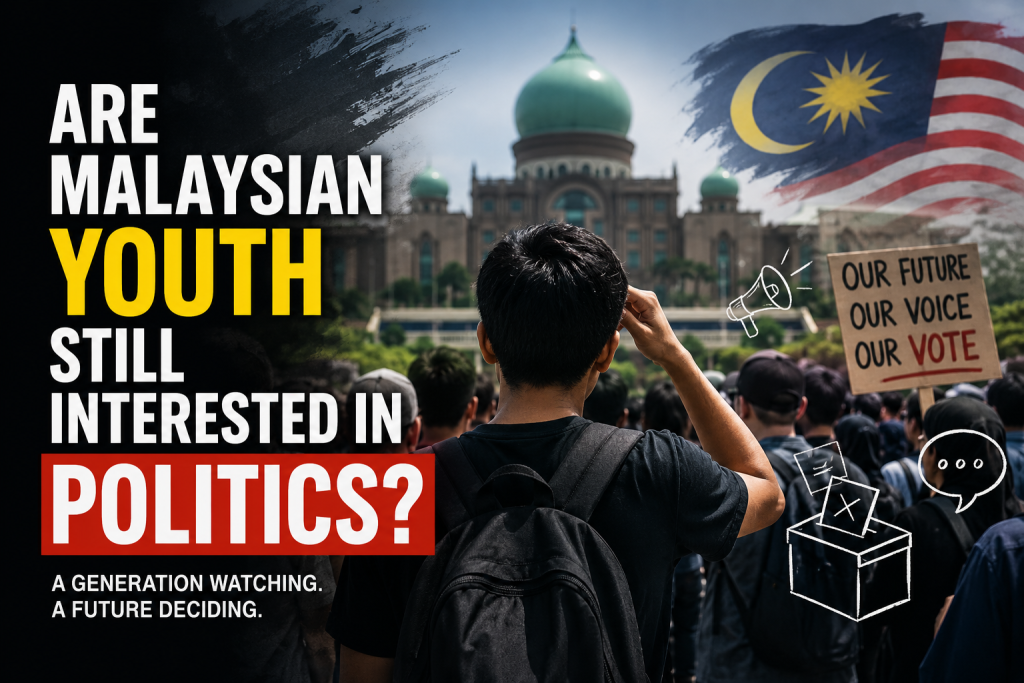
Not too long ago, politics in Malaysia felt like something distant for many young people. It was often viewed as a conversation reserved for older generations — something discussed passionately at coffee shops, ceramah stages, or family dinner tables while the youth simply listened from the sidelines.
But things have changed.
Today, Malaysian youths are more exposed to politics than ever before. They see political debates on TikTok, breaking news on X, government announcements on Instagram, and public criticism circulating through WhatsApp groups almost every day. Politics is no longer confined to Parliament or television screens. It lives on their phones, appears on their timelines, and quietly shapes their future whether they like it or not.
Yet despite this constant exposure, a growing question remains: Are Malaysian youths truly interested in politics anymore, or are they simply tired of it?
The answer is probably somewhere in between.
Many young Malaysians still care deeply about issues affecting the country. They talk about the rising cost of living, unemployment, corruption, education quality, housing affordability, and mental health struggles. These are political issues, even if they are not always discussed in political language. The younger generation wants change, fairness, and opportunities. The problem is that many no longer believe politics alone can deliver those promises.
Years of political instability, changing governments, endless arguments between politicians, and repeated public disappointments have created fatigue among the youth. Some who once felt hopeful now feel disconnected. They see politicians attacking one another online while ordinary Malaysians continue struggling with daily expenses and uncertain futures. Over time, this creates cynicism.
For many youths, politics now feels noisy rather than meaningful.
At the same time, it would be unfair to label Malaysian youths as apathetic. The younger generation expresses political opinions differently compared to previous generations. They may not attend ceramah every week or wave party flags on the streets, but they speak through social media campaigns, online discussions, podcasts, memes, and digital activism. Some support causes rather than political parties. Others focus more on policies than personalities.
This shift is important to understand.
Young Malaysians today are less interested in blind loyalty toward politicians. They are more likely to question leaders openly regardless of political affiliation. Respect is no longer automatically given based on title or seniority. Instead, many youths judge leaders based on transparency, communication, and whether they genuinely understand rakyat issues.
The implementation of Undi18 also changed the political landscape significantly. Suddenly, millions of younger voters became part of the democratic process. Political parties rushed to attract youth attention through social media strategies and youth-friendly campaigns. However, attracting young voters online is one thing; maintaining their trust is another challenge entirely.
Many youths are now politically aware but emotionally detached. They follow issues closely, yet hesitate to fully believe in any political figure. This may explain why political enthusiasm among youths often appears inconsistent. One moment they are vocal online, the next they withdraw completely from political conversations.
Perhaps this is not because the youth have lost interest in politics, but because they are still searching for reasons to trust it again.
There is also a deeper reality many older generations sometimes overlook. Young Malaysians today are growing up in a far more financially and emotionally demanding environment. Many are worried about stable jobs, affordable homes, student debt, career pressure, and even whether they can build a comfortable future in the country. Politics matters to them, but survival often comes first.
Still, dismissing the youth as “lazy voters” or “politically ignorant” would be a mistake. Malaysian youths are watching closely. They are observing how leaders behave, how policies are implemented, and whether promises actually translate into action. They may not always speak loudly, but that does not mean they are not paying attention.
In many ways, the future of Malaysian politics may depend less on whether youths are interested in politics, and more on whether politics is still interested in genuinely serving the youth.
Because trust, once lost, is difficult to rebuild.
— MINUTESMY / SUGAN BALAN