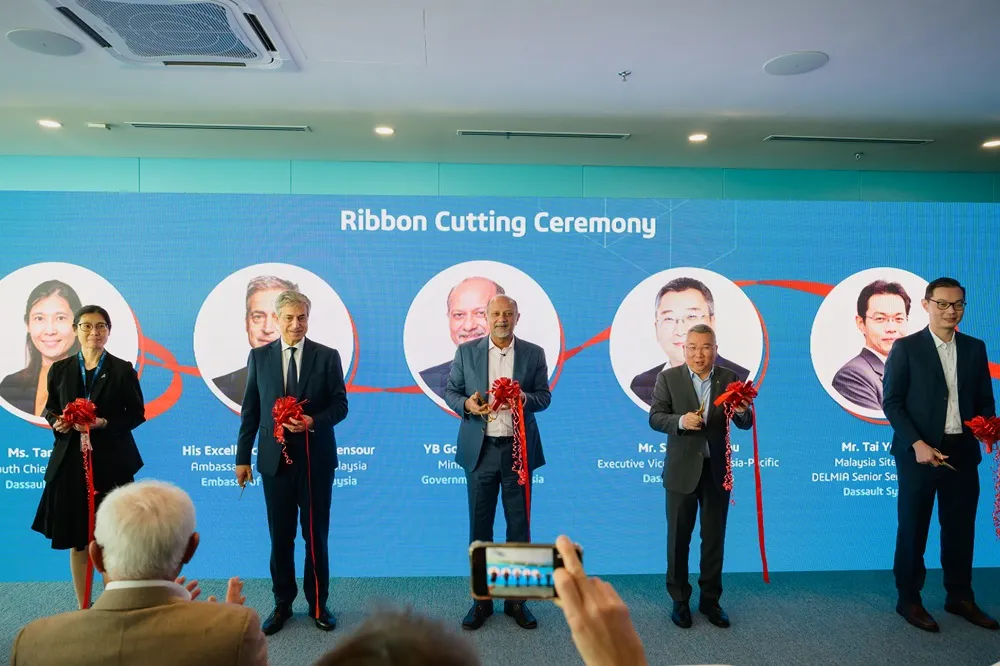
KUALA LUMPUR — French industrial technology company Dassault Systèmes has officially opened its Malaysia office, strengthening its presence in the country as Malaysia accelerates efforts to expand industrial artificial intelligence (AI), advanced manufacturing and digital transformation.
Digital Minister Gobind Singh Deo, who officiated the opening, said the company’s expansion presented an opportunity to deepen Malaysia’s industrial digitalisation capabilities and support the country’s ambition to become an AI-driven nation.
He emphasised that digital transformation must extend beyond consumer-facing applications and online services to the technologies used in factories, vehicles, aerospace and data centres, where AI could deliver significant improvements in productivity, innovation and competitiveness.
“Industrial digitalisation is where artificial intelligence will do its most consequential work,” he said.
Dassault Systèmes, which has more than 40 years of experience in industrial software, provides digital solutions that support product design, engineering, manufacturing and lifecycle management. Its technologies include virtual twins, which enable businesses to create digital representations of physical products, production lines and industrial facilities to simulate and optimise performance before implementing changes in the real world.
Gobind said such capabilities could help Malaysian manufacturers improve efficiency and compete internationally by enabling them to innovate and adapt faster, rather than relying solely on greater capital investment.
Supporting Malaysia’s industrial ambitions
The opening comes as Malaysia strengthens its position in the global semiconductor and advanced manufacturing industries under initiatives including the National Semiconductor Strategy and the New Industrial Master Plan 2030.
Gobind noted that Malaysia, already a major player in semiconductor assembly, testing and packaging, was working to expand into higher-value activities such as integrated circuit design, advanced packaging and semiconductor equipment. He cited the IC Design Park in Puchong as an example of efforts to build domestic capabilities.
He said virtual twin technology could also help manufacturers plan and optimise production facilities, improve workforce readiness and enhance operational performance before making costly physical changes.
In aerospace, the technology could support Malaysia’s maintenance, repair and overhaul (MRO) and aerostructures industries through improved aircraft configuration management and maintenance throughout an aircraft’s operational life.
The automotive sector could similarly benefit as national carmakers and their suppliers navigate the transition towards electric and software-defined vehicles, where digital integration across design, manufacturing and after-sales services is becoming increasingly important.
Gobind also highlighted the country’s growing data centre industry, stressing that Malaysia must ensure the infrastructure being developed translates into tangible benefits for local industries.
Beyond hosting computing infrastructure, he said, Malaysia should focus on enabling domestic companies to use these resources to strengthen their manufacturing capabilities, develop new products and drive innovation.
Call for greater SME access to technology
Gobind called on Dassault Systèmes to support Malaysian small and medium enterprises (SMEs) by making its technologies more accessible and providing practical, hands-on training to help businesses adopt industrial digitalisation.
He urged the company to establish measurable commitments for its Malaysian operations, with support from the Digital Ministry and the Malaysian Digital Economy Corporation (MDEC).
The minister said the government was working through AI Malaysia Berhad to develop governance frameworks, talent programmes and sector-specific initiatives to encourage responsible AI adoption. MDEC and the country’s wider digital economy initiatives are also helping strengthen the data, connectivity and cybersecurity foundations needed for industrial AI.
He added that coordination between digital and industrial policies, involving agencies such as the Ministry of Investment, Trade and Industry (MITI) and state governments, would be crucial to ensuring that businesses could translate technological advances into economic value.
Strengthening Malaysia-France technology cooperation
Gobind said Malaysia could draw lessons from France’s established industrial technology ecosystem, particularly in sectors such as aerospace, nuclear technology and advanced manufacturing, where sustained investment and research have helped develop globally competitive industries.
He described partnerships such as Dassault Systèmes’ expansion in Malaysia as important to the country’s ambition to become an AI nation and further strengthen its digital economy.
Welcoming the company’s decision to expand its presence in Malaysia, Gobind said its local team would play a role in supporting Malaysian customers as well as businesses across the region.
The opening marks another step in Malaysia’s efforts to strengthen the adoption of industrial digital technologies, with the government looking to ensure that AI and digitalisation deliver benefits not only to large corporations but also to local manufacturers and SMEs.
As Malaysia moves towards higher-value industrial activities, access to advanced engineering software, digital simulation and AI-enabled production tools will be increasingly important in building a more productive, innovative and globally competitive economy.
-PRESSKL