
Bharathiraja: The Filmmaker Who Brought Tamil Nadu’s Soul to the Silver Screen
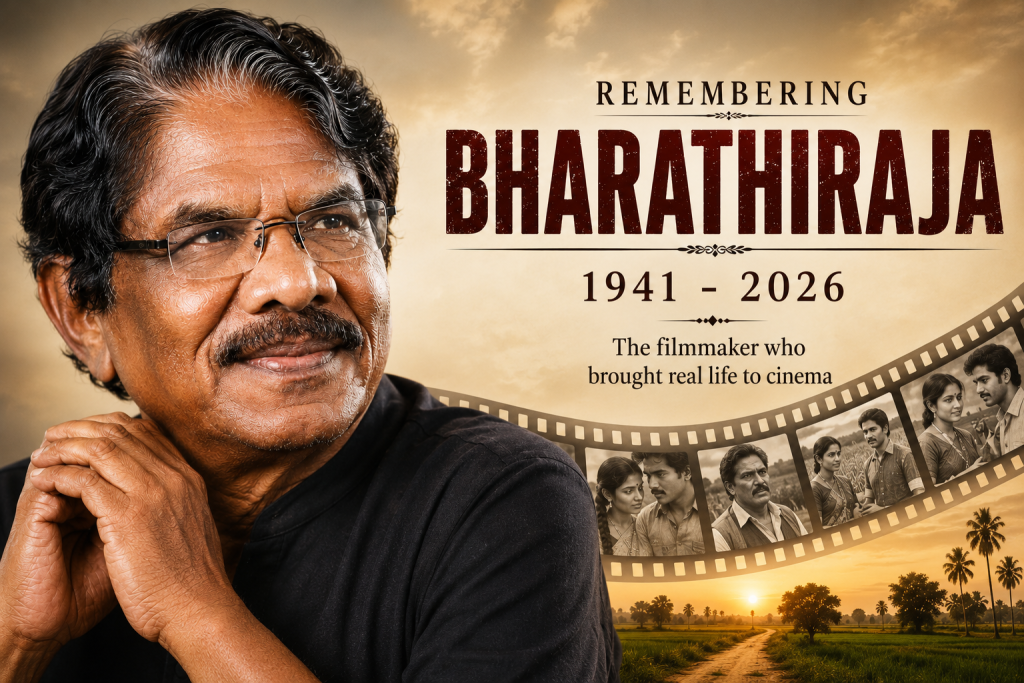
The passing of Bharathiraja marks the end of one of the most transformative chapters in Indian cinema. More than a director, he was a storyteller who changed the language of Tamil filmmaking and redefined how ordinary people, especially those from rural India, were portrayed on screen. His death at the age of 84 leaves behind a legacy that will continue to inspire generations of filmmakers and film lovers alike. Before Bharathiraja arrived in the late 1970s, Tamil cinema was largely dominated by studio sets, urban narratives and theatrical storytelling. Then came 16 Vayathinile in 1977, a film that broke conventions and introduced audiences to the raw beauty of village life. With dusty roads, green fields and characters who spoke the language of ordinary people, Bharathiraja brought realism to Tamil cinema in a way that had rarely been seen before. Many critics regard the film as a turning point that changed the course of South Indian filmmaking. What made Bharathiraja extraordinary was not merely his ability to tell stories but his commitment to telling stories that mattered. Through films such as Muthal Mariyathai, Vedham Pudhithu, Karuthamma and Kizhakku Cheemayile, he explored themes of caste discrimination, social inequality, female infanticide, love, honour and human dignity. At a time when commercial cinema often shied away from uncomfortable truths, Bharathiraja confronted them with courage and conviction. His influence extended far beyond the stories he told. Bharathiraja became a launching pad for countless talents who would later dominate Indian cinema. Actors, writers, technicians and musicians found opportunities under his guidance. His keen eye for talent helped shape the careers of many artists who went on to become household names. He was affectionately known as "Iyakkunar Imayam" — the "Peak of Directors" — a title earned through decades of artistic excellence rather than mere popularity. Despite achieving immense success, Bharathiraja never lost touch with his roots. His films consistently celebrated the culture, traditions and emotional complexities of rural Tamil Nadu. He gave a voice to communities that were often overlooked by mainstream cinema and ensured that their stories became part of the larger cultural conversation. In doing so, he preserved a slice of Tamil heritage for future generations. His achievements were recognised nationally and internationally. Over a career spanning nearly five decades, he won six National Film Awards and numerous other honours, including the Padma Shri, one of India's highest civilian awards. Yet his greatest achievement cannot be measured by trophies or accolades. It lies in the emotional connection millions of viewers felt with the worlds he created. In recent years, Bharathiraja faced declining health and personal tragedy, including the heartbreaking loss of his son, actor-director Manoj Bharathiraja. Yet even as age slowed him physically, his influence on Indian cinema remained undiminished. Today, as tributes pour in from across the film industry, Tamil cinema mourns not just the loss of a filmmaker but the loss of a visionary who changed the way stories were told. Bharathiraja showed that cinema could be both artistic and accessible, entertaining and socially relevant. He proved that the most powerful stories often emerge from the lives of ordinary people. The lights may have dimmed on the life of Bharathiraja, but the worlds he created will continue to live on. Every time a filmmaker ventures beyond the city to tell a story rooted in the soil, every time a film challenges social injustice through human emotion, and every time audiences connect with the authenticity of rural life on screen, Bharathiraja's spirit endures. Legends do not disappear when they die. They become part of a culture's collective memory. Bharathiraja is now one such legend.

The passing of Bharathiraja marks the end of one of the most transformative chapters in Indian cinema. More than a director, he was a storyteller who changed the language of Tamil filmmaking and redefined how ordinary people, especially those from rural India, were portrayed on screen. His death at the age of 84 leaves behind […]

Absence Of Money Trail Does Not Compromise Corruption Case Against Lim Guan Eng, Court Hears
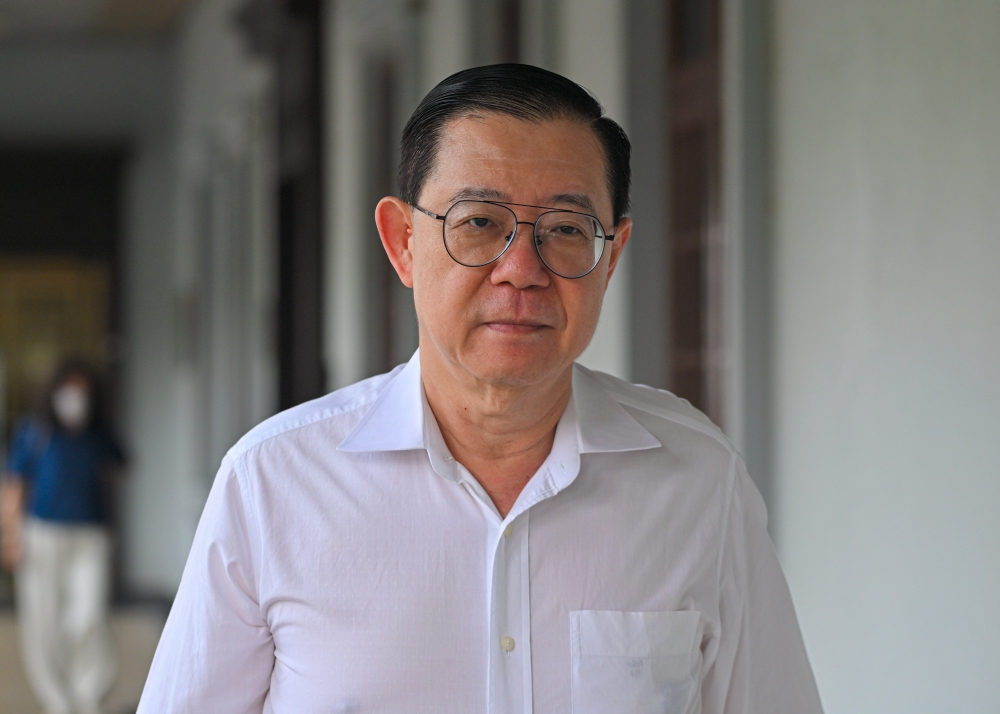
KUALA LUMPUR, May 6 -- An investigating officer informed the Sessions Court today that the absence of a money trail has not compromised his investigation into the Penang undersea tunnel corruption case involving Lim Guan Eng. Malaysian Anti-Corruption Commission (MACC) Investigation Division senior officer Zulhilmi Ramli explained that the RM3.3 million allegedly given to the former Penang Chief Minister was delivered in cash in stages, and was never banked or transferred into his account, thereby leaving no trace. "However, this did not affect my investigation, as it is supported by the testimony of the key witness, Datuk Zarul Ahmad Mohd Zulkifli, a former director of Consortium Zenith Construction Sdn Bhd (CZCSB). “It is further corroborated by other witnesses, namely (Datuk Seri) G Gnanaraja (a businessman), Azli Adam (former senior vice president of Finance and Corporate Services at Consortium Zenith Beijing Urban Construction Group Sdn Bhd), and Ibrahim Sahari (a former director of CZCSB). "All of them confirmed that cash withdrawals took place and that meetings occurred between Zarul Ahmad and the accused at the latter's office. My investigation also relies on documents I obtained, which indicate that meetings were held inside a car involving Zarul Ahmad, Gnanaraja and the accused. “This evidence is further reinforced by forensic reports, including photographs taken inside the car and at the house," he said. The 38th prosecution witness was testifying during examination-in-chief by deputy public prosecutor Datuk Wan Shaharuddin Wan Ladin. Wan Shaharuddin: Why did the MACC still select Gnanaraja as a witness despite defence claims of contradictions between his statement and Zarul Ahmad's? Zulhilmi: I considered Gnanaraja's statement regarding the RM2 million payment to the accused, which is supported by Zarul Ahmad's testimony. In his statement at the end of 2019, Zarul Ahmad admitted and confirmed that four bags, each containing RM1 million, were given to Gnanaraja. “I also took into account Gnanaraja's statement recorded around mid-2020, which was consistent. Gnanaraja admitted to receiving four bags of RM1 million each, and that the total amount received from Zarul Ahmad was RM4 million. Under the first charge, Lim, 65, is accused of abusing his position as Penang chief minister to receive RM3.3 million in return for helping a company owned by businessman Zarul Ahmad secure the Penang Major Roads and Tunnel Construction Project, valued at approximately RM6.34 billion. The alleged offence took place at the Penang Chief Minister's Office between January 2011 and August 2017. The second charge states that the Bagan MP solicited a 10 per cent cut out of the project’s future profits from Zarul Ahmad for assisting his company in securing the same project. The alleged offence occurred near The Gardens Hotel, Lingkaran Syed Putra, Mid Valley City, Kuala Lumpur, between 12.30 am and 2.00 am in March 2011. Additionally, Lim faces two charges of disposing of a couple of state-owned lots of land in Penang, valued at RM208.8 million, to a developer linked to the undersea tunnel project. These offences were allegedly committed at the Penang Land and Mines Office, Komtar, on Feb 17, 2015, and March 22, 2017. The trial before Judge Azura Alwi resumes on May 14. -- BERNAMA

KUALA LUMPUR, May 6 — An investigating officer informed the Sessions Court today that the absence of a money trail has not compromised his investigation into the Penang undersea tunnel corruption case involving Lim Guan Eng. Malaysian Anti-Corruption Commission (MACC) Investigation Division senior officer Zulhilmi Ramli explained that the RM3.3 million allegedly given to the […]