Computex 2026: AMZFAST Expands Beyond Gaming Monitors with Smart Displays, OLED Technology and 400Hz Esports Performance
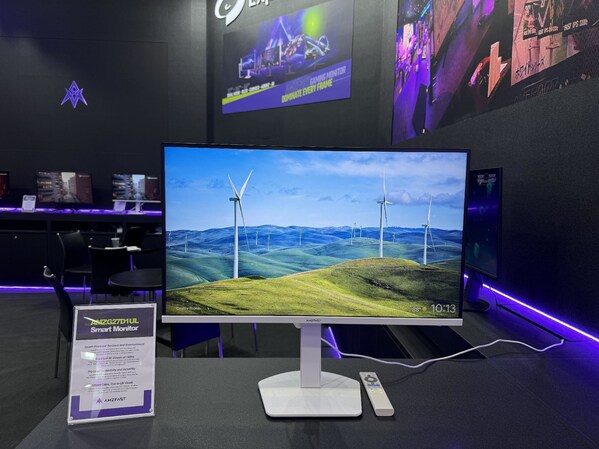
TAIPEI, June 5 -- At Computex 2026, AMZFAST unveiled its most ambitious display lineup to date, expanding beyond traditional gaming monitors into smart entertainment, premium OLED gaming, creator-focused displays, and ultra-high-refresh esports technologies. Leading the showcase is the AMZG27D1UL Smart, a 27-inch 4K 160Hz display that combines gaming performance with integrated Google TV functionality. Equipped with Dolby Audio, VRR support, and 65W USB-C Power Delivery, the monitor allows users to access streaming services directly without an external device, positioning it as a hybrid solution for gaming, entertainment, and productivity. AMZFAST also entered the OLED category with the AMZG27P1Q OLED. Featuring a fourth-generation 280Hz OLED panel, HDR True Black 500 certification, 98% DCI-P3 coverage, and a 0.03ms response time, the monitor is designed to deliver both competitive gaming responsiveness and premium visual quality. For esports enthusiasts, the company introduced the AMZG27F6AQ and AMZG25F6Q, offering refresh rates of up to 400Hz and 380Hz respectively. Both models incorporate AMZFAST's AI Gaming suite, including Night Vision, AI Crosshair, Sniper Scope, AI Picture Quality, and AI Dynamic Blue Light technologies. The lineup also includes the AMZG27D1UL DUAL Mode, which allows users to switch between 4K/160Hz and FHD/320Hz modes with a single click, providing flexibility between visual immersion and competitive performance. Beyond gaming, AMZFAST showcased several creator and productivity displays. The AMZG34C85L features a 34-inch 5K2K ultrawide format with 98% DCI-P3 coverage, while the B27A2U combines a 4K 120Hz IPS panel, 99% DCI-P3 color accuracy, and 90W USB-C charging for professional workflows. The AMZG49C7 flagship delivers a 49-inch 5K DQHD super-ultrawide experience equivalent to two QHD monitors in a single seamless display. Throughout Computex, the AMZFAST booth attracted media representatives, content creators, channel partners, and buyers from Japan, Europe, and North America. Company representatives, including Regional Marketing Manager Leo NG, participated in a series of interviews and product demonstrations highlighting the company's vision for next-generation gaming, entertainment, and professional display experiences. "Today's users increasingly expect a single display to support gaming, entertainment, and productivity," said Leo NG, Assistant Regional Marketing Manager at AMZFAST. "Our Computex 2026 portfolio reflects that shift while continuing to push performance boundaries for competitive gamers and professional users alike." Products showcased at Computex 2026 are expected to launch across North America, Europe, and Japan in the second half of 2026. Selected models, including the AMZG34C8Q and AMZG49C7, are already available through Amazon and regional retail channels. For more information, visit: www.amzfast.net About AMZFAST AMZFAST is a gaming and esports monitor brand under Express Luck Group, backed by more than 29 years of smart display manufacturing expertise. The brand offers display solutions spanning gaming, entertainment, creator, and professional applications and has received international recognition including the Red Dot Design Award 2026, CES Innovation Awards, IDPA Japan Design Award, MUSE Design Awards, and American Good Design Awards. -- PRNewswire -- Source: AMZFAST

TAIPEI, June 5 — At Computex 2026, AMZFAST unveiled its most ambitious display lineup to date, expanding beyond traditional gaming monitors into smart entertainment, premium OLED gaming, creator-focused displays, and ultra-high-refresh esports technologies. Leading the showcase is the AMZG27D1UL Smart, a 27-inch 4K 160Hz display that combines gaming performance with integrated Google TV functionality. Equipped […]

ARTi Makes Its Official Debut — DL Holdings Writes a New Chapter

HONG KONG, June 5 -- On June 4, 2026, ARTi — DL Holdings' institutional-grade AI investment research platform — signed a subscription agreement with C Capital, a prominent Asia-Pacific technology investment firm. C Capital subscribed to 4.76% of ARTi's Class B shares (500 shares) at a price of USD 1.5 million. These shares carry no management or voting rights and entitle holders solely to financial returns. ARTi's pre-money valuation stands at USD 30 million. This Pre-Series A funding announcement marks the first time this AI application, quietly nurtured by DL Holdings, has come into public view — making a comprehensive introduction to investors both timely and necessary. ARTi is an AI intelligent platform independently developed by DL Holdings, equipped with institutional-grade investment research capabilities. It has achieved structured, data-driven analysis with traceable investment reasoning, forming a complete closed loop of "judgment + recording + verification + capability accumulation" that meets the needs of investors of all types. ARTi currently provides full AI-agent investment advisory and AI-agent investment decision-making services, with AI-agent investment execution and other services to follow in the future. DL Holdings began exploring AI as early as 2023, launching applications such as AI digital humans, AI smart advisors, and AI robots. Today, built upon a proprietary multi-agent AI technology architecture platform, ARTi is capable of delivering institutional-grade investment research. This represents a milestone breakthrough for DL in the AI domain. Leveraging vast, high-quality financial data and deep insight at the level of investment logic, ARTi has achieved institutional-grade investment research capabilities that far surpass the general-purpose large language models available on the market, enabling investors to pursue stable compounding growth. I. What Sets ARTi Apart? There is no shortage of general-purpose large language models on the market today. They are undeniably useful in high-error-tolerance contexts — translating documents, summarizing key points, getting up to speed on a new field. If prompted, they can even help analyze funds or stocks. But these models cannot be relied upon to guide real investment decisions. The reason is hallucination: general-domain error rates average around 5%, while in professional financial contexts that figure approaches 14%. ARTi systematically reduces the risk of AI hallucination in financial domains through multi-dimensional cross-validation of data and traceable reasoning logic. How does DL achieve this? In short: DL's "3×8" framework — 8 AI analysts × 8 investment masters × 8-layer data architecture. This system's research capabilities already surpass those of general-purpose models available on the market. 1. The highest-quality data produces the most reliable results. Inaccurate data renders analysis meaningless. Insufficient data inevitably creates blind spots. And without proper data organization, the hallucination problem in large language models cannot be solved. ARTi's real-time market data feeds, structured processing of listed company financial reports, global regulatory updates, and macro data all come from authoritative sources — the same data accessible to conventional vertical financial models. DL goes further, adding leading signals of corporate strategy, including recruitment data, patent filings, and government procurement records, as well as proprietary supply chain relationship data, equity structures, exchange announcements, and news. On top of all that, individual portfolio holdings, decision histories, and forecast accuracy records are incorporated. DL also brings over a decade of live trading data and decision logic accumulated through its family office practice, forming a powerful data moat. 2. The clearest logic produces the highest-quality algorithms. ARTi's three-layer analytical logic is its core competitive advantage. The first layer consists of eight independently trained AI analysts covering macro, fundamental, technical, and risk assessment dimensions, alongside eight AI investment masters conducting independent analyses from their respective methodologies — a format dubbed "roundtable debate" — culminating in cross-validation and the surfacing of divergences. The second layer evaluates the constraint conditions governing each investment conclusion. Every investment judgment must be grounded in cross-validated findings from the 8-layer data architecture. Each judgment must directly include the reasoning logic, underlying assumptions, and triggering factors — and every conclusion must be fully traceable, with no unexplained outputs. The third layer records these verifiable conclusions. As each judgment is generated, the system automatically logs its content, timestamp, and market context, then continuously monitors it. As markets evolve, these judgments are either confirmed or refuted. In this way, ARTi's algorithms shift from "expressing opinions" to "verifiable objects." In other words, ARTi functions as the verification layer for investment judgments. Compared with existing AI tools, this analytical system offers the following distinct advantages: outputs can be cross-validated to highlight key insights; the reasoning logic behind each judgment is recorded, and market developments are tracked against it to determine whether the judgment was right or wrong; and this history of judgments forms a highly personalized context for each investor — meaning the platform understands each user better over time. II. DL Holdings at the Forefront — Again DL's vision has never changed: Investing Made Simple. DL has always worked to share the service experience accumulated in the family office space with a broader base of investors. Whether through DL's digital family office, NeuralFin (突触科技), MiCang (米倉), AI digital humans, AI smart advisors, or AI robots — everything has been built toward that goal. In a word, DL has consistently chosen to do things that are hard but right. Global financial institutions are all navigating the waves of AI, blockchain, and Web3.0. Robinhood has focused on the trading layer: in April 2023, Robinhood Connect bridged the gap between traditional centralized finance and the decentralized world; in October 2024 it launched prediction contracts tied to the U.S. presidential election; and in June 2025 it entered the blockchain securities space, enabling European users to trade over 200 U.S. stocks and ETFs on the Arbitrum network via blockchain-based tokens. DL's internal discussions and instincts around decentralized applications — including prediction markets and tokenized financial assets — predate these trading platforms. But given Hong Kong SAR's regulatory realities and DL's mission to make investing accessible to everyone, DL chose the harder path: moving upstream from execution to decision support. DL wants every investor to have access to professional investment research capabilities and top-tier financial services — and that ambition is what gave rise to ARTi. 1. Institutional-grade research capabilities — where judgment compounds. ARTi's value will not accumulate linearly; it will grow flywheel-style, and its moat will become extraordinarily wide. This is the market's reward for consistently doing what is hard but right. Just as Tencent's position in social networking is theoretically replicable — anyone could build a WeChat or QQ clone with AI today — no one can replicate the stickiness of WeChat's massive user base. ARTi is building the same kind of compounding dynamic: as users engage with ARTi, their judgments are recorded, outcomes are verified, verification results are analyzed to distill methodology, methodology comparison drives continuous system optimization, and system optimization produces better future judgments. This is the flywheel effect. Ultimately, ARTi's data moat, methodological moat, and network effects will become its most formidable competitive defenses. 2. ARTi's memory mechanism — making time itself a barrier. A user who has spent three years with ARTi possesses three years of judgment records, verification data, and personalized feedback curated by ARTi. No competitor can replicate that in the short term — because the user's history of judgments is the most valuable investment asset they own, and ARTi has structured it all, turning it into a solid foundation for every future investment decision. Time itself becomes the most durable barrier. ARTi currently covers three major markets — A-shares (Shanghai and Shenzhen), H-shares (Hong Kong SAR), and U.S. equities — with plans to expand into Japan and other Asia-Pacific markets, while also broadening its product coverage to include bonds, ETFs, and other mainstream financial instruments. Looking ahead, ARTi will progressively enable investors to connect their own legitimate investment accounts, allowing them to leverage ARTi's research capabilities and judgment loop to execute trades autonomously via AI agents — including portfolio construction, automated trading strategies, and order placement. For retail users, ARTi can be integrated directly into Telegram, WhatsApp, and Web Apps; for professional users, CLI and API access will be available; for institutional partnerships, ARTi offers white-label solutions and a Skills API. III. ARTi Empowers DL's Three Core Business Segments 1. Family Office The family office segment serves ultra-high-net-worth individuals with investable assets of USD 30 million or above. ARTi's "AI Investment Committee" is already capable of assisting and participating in DL's family office investment decisions. In the future, ARTi will open access to family offices and investment institutions in Hong Kong SAR and globally, offering API integration services. 2. Professional Investors DL Securities' core client base consists of Professional Investors in Hong Kong SAR — individuals with investable assets exceeding USD 1 million. Through serving them, DL has developed an acute understanding of their demand for high-quality investment decision-making, as well as the efforts they make to sharpen their investment capabilities. In the future, ARTi will deliver AI investment research services directly to all Professional Investors through DL Securities, with plans to extend the same quality of service to other domestic and international brokerages. This will meaningfully enhance brokers' ability to serve their clients — a win-win for all parties. 3. Retail and Prospective Investors In serving retail and prospective investors, DL's NeuralFin (突触科技) is approaching the one-million-user milestone, and MiCang (米倉) — the app targeting mainland Chinese users — is now live on app stores. In the future, all of these users will be able to experience the full power of ARTi firsthand. ARTi's Ultimate Vision: Infrastructure for the Investment Judgment Layer In today's investment chain, the information aggregation layer has mature incumbents like Bloomberg — universally recognized as the infrastructure of financial information. At the trade execution layer, exchanges and electronic trading systems in every market have become standard infrastructure. But the investment judgment layer — arguably the most important — remains wide open. ARTi aspires to become the foundational infrastructure of this layer, and at the right time, DL intends to open-source ARTi. That is DL's choice, and its responsibility. ARTi is headquartered in Tokyo, with R&D centers in Tokyo and Silicon Valley, and offices in Hong Kong SAR and Singapore. -- PRNewswire -- Source : DL Holdings

HONG KONG, June 5 — On June 4, 2026, ARTi — DL Holdings’ institutional-grade AI investment research platform — signed a subscription agreement with C Capital, a prominent Asia-Pacific technology investment firm. C Capital subscribed to 4.76% of ARTi’s Class B shares (500 shares) at a price of USD 1.5 million. These shares carry no […]

AI cannot replace the experience of journalists in the field – Expert

KOTA BHARU: The ability to master artificial intelligence (AI) technology in the newsroom world is no longer considered an option, but rather a critical necessity in facing an increasingly challenging and competitive media landscape. As digital change moves at a rapid pace, media organizations' failure to integrate AI technology into operations can not only affect efficiency and productivity but also risk falling behind in the competition to remain relevant to audience needs. However, despite the advantages of technology that can speed up news production, concerns have arisen about excessive reliance on AI and digital sources, which are feared to erode the fundamental values ​​of journalism, including the grassroots culture that is the backbone of quality reporting. The concern stems from an ongoing debate about the tendency of some reports to rely too heavily on information on social media or online sources, which is then processed using AI without direct verification at the scene. Senior Lecturer at the Faculty of Modern Languages ​​and Communication, Universiti Putra Malaysia (UPM), Dr Syed Agil Shekh Alsagoff said that AI can indeed be an effective tool to increase productivity in newsrooms, but it cannot replace the experience and editorial judgment of journalists in the field. He said that the main strength of journalists in producing high-impact reports remains their ability to see the real situation for themselves, meet with the community and obtain confirmation from various sources before a piece of news is published. "If journalists rely too much on AI and digital sources, the culture of going to the field will diminish, whereas the presence of journalists in the field is very important to understand the true context of an issue and obtain a more accurate picture," he told Bernama. Syed Agil said that the field approach not only provides valuable experience to journalists, but also helps produce more comprehensive reports with stronger narratives based on direct observations at the scene. He explained that the situation is different from reports that rely too much on AI and social media, which risks making the news "bland" because technology is only capable of processing data without understanding the emotions and sensitivities of society. "The experience of being on the scene of an incident allows journalists to understand the emotions, atmosphere and real reality that technology cannot fully translate. For example, when a disaster occurs, journalists who go to the field can better translate the news narrative. "While AI and social media can only help produce reports quickly, they cannot replace the experience of journalists who see firsthand the suffering of victims, the fear during conflicts and the grief of families who have lost loved ones," he said. In this regard, Syed Agil stressed that journalism is not just about presenting facts but also involves understanding the pulse of humanity and the reality of society, in addition to demanding the production of ethical reports through presence in the field. At the same time, he did not deny the benefits of AI if used wisely, especially in research, data analysis and multimedia content production, but it still needs to be balanced with the basic values ​​of journalism. "AI is an aid, journalists still need to go out into the field to see, hear and understand an issue for themselves. Without that element, reports may be completed quickly but lose their soul and human values," he said. Therefore, in conjunction with the celebration of National Journalists' Day (HAWANA) 2026 on June 20, he said, it should be used as a platform to strengthen the balance between technological advancements and human values ​​in journalism to ensure that the media industry continues to be relevant and trusted by the community. Themed "Media with Integrity, Credibility at the Core", the highlight of this year's HAWANA celebration will take place at the PICCA Convention Centre @ Arena Butterworth, Penang, and will be officiated by the Prime Minister, Datuk Seri Anwar Ibrahim. Organised by the Ministry of Communications with the Malaysian National News Agency (Bernama) as the implementing agency, HAWANA is a platform to acknowledge the contributions, perseverance and professionalism of media practitioners in Malaysia. -- BERNAMA

KOTA BHARU: The ability to master artificial intelligence (AI) technology in the newsroom world is no longer considered an option, but rather a critical necessity in facing an increasingly challenging and competitive media landscape. As digital change moves at a rapid pace, media organizations’ failure to integrate AI technology into operations can not only affect […]

Simpang Renggam crash: Teenager remanded for 4 days for murder investigation

KLUANG, JUNE 5 -- The 19-year-old male driver involved in an accident that claimed five lives on Jalan Renggam–Simpang Renggam last Monday was remanded today for investigation under Section 302 of the Penal Code for murder. The teenager involved was remanded for four days until next Monday after a remand order was issued by Judge Mujib Saroji at the Kluang Sessions Court, here this morning. Earlier, the suspect, wearing a brown shirt, arrived at the courthouse at 8.45am, closely escorted by police officers. The suspect was previously released on police bail after being remanded for three days until yesterday for investigation under Section 42(1) of the Road Transport Act 1987. However, the police re-arrested the suspect to enable an investigation to be conducted under Section 302 of the Penal Code. The accident on June 1 at Kilometer 27, Jalan Renggam–Simpang Renggam caused a family of four who were travelling in a Toyota Vios, including a 10-year-old girl, to die at the scene. The teenager is suspected of driving a Mercedes Benz A250 recklessly and dangerously alongside a BMW 530e driven by his 22-year-old brother, who also died on the way to the hospital. -- BERNAMA

KLUANG, JUNE 5 — The 19-year-old male driver involved in an accident that claimed five lives on Jalan Renggam–Simpang Renggam last Monday was remanded today for investigation under Section 302 of the Penal Code for murder. The teenager involved was remanded for four days until next Monday after a remand order was issued by Judge […]

Putin will not attend the 2026 FIFA World Cup in the US – Kremlin

ST PETERSBURG: Russian President Vladimir Putin will not attend the 2026 FIFA World Cup in the United States (US), Kremlin spokesman Dmitry Peskov told RIA Novosti. Earlier, US President Donald Trump said he might invite Putin to the 2026 FIFA World Cup in the US. "Putin is not going away," Peskov said. The 2026 FIFA World Cup will take place in three countries, namely the United States, Canada and Mexico from June 11 to July 19. -- BERNAMA-SPUTNIK/RIA NOVOSTI

ST PETERSBURG: Russian President Vladimir Putin will not attend the 2026 FIFA World Cup in the United States (US), Kremlin spokesman Dmitry Peskov told RIA Novosti. Earlier, US President Donald Trump said he might invite Putin to the 2026 FIFA World Cup in the US. “Putin is not going away,” Peskov said. The 2026 FIFA […]