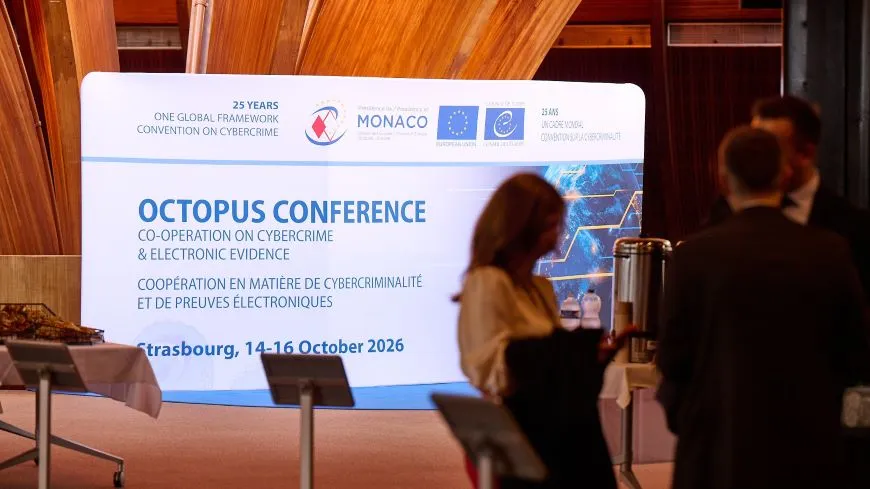
STRASBOURG, October 16 2026, Around 500 cybercrime experts from more than 100 countries, international organisations, the private sector, academia and civil society are meeting in Strasbourg for the Council of Europe’s 2026 Octopus Conference, marking the 25th anniversary of the Convention on Cybercrime, also known as the Budapest Convention.
Held from October 14 to 16, the conference provides a platform to assess the convention’s role in strengthening international cooperation against cybercrime and address emerging challenges posed by technological and geopolitical developments.
Council of Europe Secretary General Alain Berset said cybercrime threatens not only individual victims but also the institutions, rights and public trust underpinning free societies. He stressed that international legal cooperation is essential to closing gaps between national legal systems.
Monaco’s Secretary of State for Justice, Samuel Vuelta Simon, said the convention remained relevant despite significant technological and geopolitical changes. He emphasised that responses to cybercrime must enable the swift preservation of evidence and prosecution of offenders while respecting the rule of law.
Conference to Address AI and Emerging Cybercrime Threats
Discussions at the conference cover the impact of artificial intelligence (AI) on cybercrime, trafficking and scam compounds, as well as cooperation with online service providers in obtaining electronic evidence.
Participants will also examine disinformation and foreign manipulation, transnational repression, cyber-enabled international crimes, AI-generated child sexual abuse material, the non-consensual sharing of intimate images and the illegal use of virtual assets.
Regional workshops involving participants from Africa, the Americas, Asia, the Pacific and the Caribbean will provide opportunities to exchange experiences and identify practical approaches to tackling cybercrime.
The event also facilitates dialogue between public and private stakeholders and international partners on improving cross-border cooperation.
Over the past 25 years, the Budapest Convention has helped shape cybercrime legislation and international cooperation worldwide, while informing subsequent initiatives, including the United Nations treaty on cybercrime.
Kazakhstan ratified the convention during the conference period, bringing the total number of parties to 84.
The conference is organised in cooperation with Monaco’s Presidency of the Council of Europe’s Committee of Ministers under the Octopus Project, with support from the Council of Europe’s Cybercrime Programme Office (C-PROC).
Study Examines AI’s Role in Cybercrime
Ahead of the conference, the convention committee approved a mapping study on AI and cybercrime based on practical insights from prosecutors and experts in more than 25 countries.
The study examines crimes targeting AI systems, the use of AI to facilitate criminal activities and the challenges of determining criminal responsibility when AI systems are involved.
It highlights threats including data poisoning, prompt injection and model theft, alongside the use of AI to develop malware and ransomware or generate child sexual abuse material.
The report also considers the legal and accountability challenges associated with increasingly autonomous or agentic AI systems, particularly when criminal actions are not directly instructed or anticipated by their operators.
According to the study, AI systems fall within the Budapest Convention’s definition of a computer system. It also recognises AI’s potential to support crime prevention and criminal justice, while underscoring the need for human oversight, transparency, accountability and safeguards for human rights and the rule of law.
Recommendations include closer cooperation with the AI industry, online service providers and civil society, as well as the development of practical resources on AI, cybercrime and electronic evidence.
The study further calls for collaboration across relevant Council of Europe treaties, including those addressing AI and human rights and the protection of children against sexual exploitation and abuse.
New Treaty to Strengthen Criminal Asset Recovery
Separately, an additional protocol to the Council of Europe Convention on Laundering, Search, Seizure and Confiscation of the Proceeds from Crime and on the Financing of Terrorism, known as the Warsaw Convention, was opened for signature on the sidelines of the conference.
The treaty aims to modernise asset recovery frameworks in response to increasingly sophisticated and transnational criminal networks.
It is intended to strengthen authorities’ ability to confiscate criminal proceeds, including crypto-assets, as countries seek more effective ways to tackle cross-border financial crime.
-PRESSKL