SHANGHAI, Oct 29 – Chinese robotics company AGIBOT has introduced Worken, a new framework designed to measure how much productive work robots can perform in real-world environments.
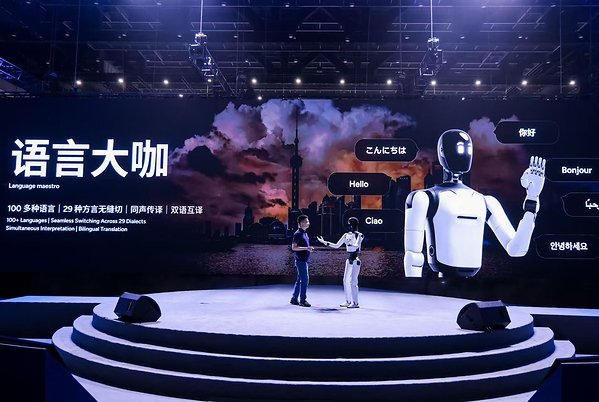
The announcement was made at AGIBOT Innovation Day 2026 in Shanghai. The company said the framework aims to measure more than the number of robots manufactured or deployed. It also considers how independently and efficiently robots complete tasks.
AGIBOT introduced Worken as part of a wider technology showcase featuring new robot hardware, artificial intelligence (AI) models and industrial applications.
Worken Introduces a New Way to Measure Robot Productivity
Worken combines the words “Work” and “Token”. AGIBOT describes it as a framework for measuring Effective Intelligent Work Hours.
The proposed formula combines three factors:
Worken = Active Robots × Autonomous Working Hours × Output Efficiency Ratio
Each factor measures a different part of robot productivity.
- Active robots: Counts machines performing actual tasks, rather than robots sitting in storage.
- Autonomous working hours: Measures the time robots work independently without human intervention.
- Output efficiency ratio: Compares completed work against an established benchmark for a specific task.
According to AGIBOT, the framework could help businesses understand the value of robots in manufacturing, logistics, inspection and commercial services.
The company also plans to refine the measurement system through operational data and real-world deployments.
AGIBOT Unveils New AI and Robotics Technology
During the event, AGIBOT introduced several technologies designed to improve robot performance.
These included AHA3, an integrated hardware platform that brings together three key capabilities: movement, interaction and task execution.
The company also presented GO-3 Preview, a next-generation AI model designed to help robots understand tasks, predict outcomes and take action.
Meanwhile, WITA-Omni focuses on human-robot interaction. It combines visual understanding, speech, real-time conversations, facial expressions and physical movements.
AGIBOT also highlighted developments in its AGILE motion intelligence framework, which aims to help robots move and adapt more effectively in changing environments.
G2 Max Targets Manufacturing and Logistics
Another major announcement was the launch of G2 Max, an industrial robot designed for demanding manufacturing and logistics operations.
According to AGIBOT, the robot features 21 degrees of freedom and a dual-arm handling capacity of up to 40kg.
It also has an adjustable working height ranging from 0.1 to 2.5 metres. Its design supports material handling and movement across industrial environments.
AGIBOT highlighted several real-world applications involving its G2 robot family. These include tablet production, semiconductor packaging, CNC machine operations and warehouse logistics.
The company also showcased applications in public transport and visitor services, including deployments at Guangzhou Metro and the Chimelong tourism complex.
Link-U OS 1.0 Supports Robot Development
AGIBOT also officially launched Link-U OS 1.0, an operating system developed for embodied AI.
Embodied AI refers to artificial intelligence operating through physical systems, such as robots that interact with the real world.
The operating system connects robot hardware with intelligent applications. It is designed to support development, testing and deployment across different robotic systems.
AGIBOT said selected partners are currently testing Link-U OS 1.0. The company plans to make the system fully open source by the end of 2026.
It is also working with the OpenAtom Foundation to support an open-source community for humanoid robotics.
AGIBOT Focuses on Practical Robot Deployment
Beyond product launches, AGIBOT highlighted the importance of moving robotics from development and testing into everyday operations.
The company said businesses should measure how consistently robots complete useful tasks, rather than focusing only on production numbers.
Its Worken framework reflects this approach by combining deployment levels, independent working time and task performance.
AGIBOT hopes the concept will help businesses evaluate robot productivity across different industries as physical AI technology continues to develop.
For more information, visit the official AGIBOT website.
Source: PR Newswire | Rewritten By Minutesmy