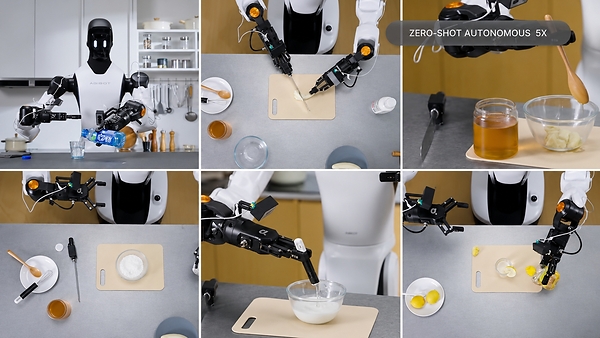
SHANGHAI, November 3 – Chinese robotics company AGIBOT has unveiled GO-3 Preview, a new artificial intelligence (AI) model designed to help robots learn, perform tasks and improve through real-world experience.
The company said the model achieved first-place rankings in three embodied AI benchmarks: RoboDojo, RoboTwin and RoboColiseum.
AGIBOT also plans to make GO-3 Preview fully open-source by the end of 2026.
New AI Model Connects Three Learning Stages
GO-3 Preview introduces an approach that connects three stages of robot learning: pre-training, post-training and learning after deployment.
This allows robots to build general skills, improve through practice and adapt while performing real tasks.
AGIBOT developed the model using its World Reasoning Action Model (WRAM) architecture.
The system connects three key abilities. These include understanding instructions, predicting what may happen next and generating suitable actions.
For example, a robot asked to pick up a cup must recognise its shape and position. It must also adjust its movements based on nearby objects.
This approach aims to help robots handle different environments instead of relying on fixed instructions.
Robots Learn Through Real and Virtual Practice
AGIBOT has also introduced Genie Evolver, a training system that combines physical robots with computer simulations and world models.
According to the company, the system uses a fleet of 100 physical robots.
It allows robots to learn from successful tasks and mistakes. They can also practise different actions in simulated environments before applying them in the real world.
AGIBOT demonstrated the system through several tasks.
These included tabletop curling, removing blocks from a stack and throwing a ball into a moving basket.
The company said its robot achieved a higher win rate than typical human players in tabletop curling after several hours of combined real-world practice and world-model learning.
Robots Can Improve After Deployment
Another key feature is Genie Master, AGIBOT’s framework for helping robots learn while working in real environments.
The system connects task planning, execution, feedback and stored experience.
It allows robots to identify problems, adjust their strategies and use lessons from earlier tasks.
AGIBOT demonstrated this approach using its Genie G2 robot in a convenience store.
The company said the robot could identify task failures, change its approach and improve its performance across several complex activities.
This approach aims to reduce the need for constant human adjustments during robot operations.
GO-3 Builds on AGIBOT’s Earlier AI Models
GO-3 Preview follows AGIBOT’s earlier GO-1 and GO-2 models.
The company said the latest model expands robot learning beyond initial training. It also focuses on improvement through physical interaction and real-world work.
By connecting these learning stages, AGIBOT aims to help robots develop skills that can be reused and improved over time.
The company believes this approach could support more capable robots for practical tasks across different working environments.
AGIBOT said it plans to fully open-source GO-3 Preview by the end of 2026.
Source : PR NEWSWIRE | Rewritten By Minutesmy