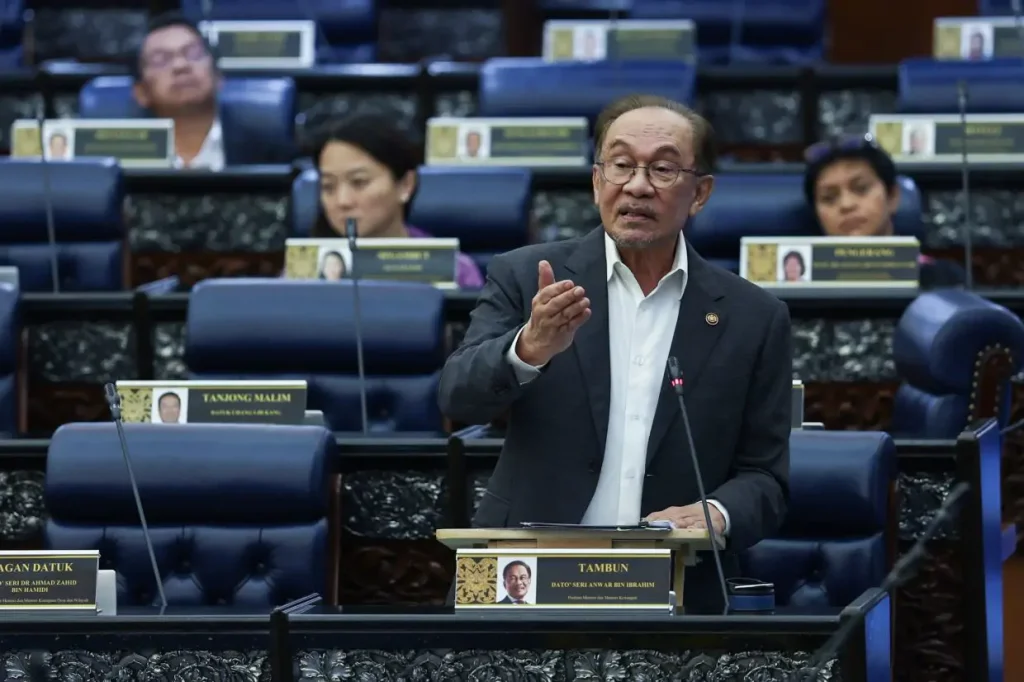
KUALA LUMPUR, Nov 12 – Prime Minister Datuk Seri Anwar Ibrahim has explained that Malaysia’s government borrowings help fund national development and settle financial obligations inherited from previous administrations.
He said the government uses borrowed funds to finance essential projects, including schools, hospitals, roads, and water and electricity infrastructure.
Anwar, who is also Finance Minister, highlighted that the government needed RM13 billion in 2023 to redeem bonds linked to 1Malaysia Development Bhd (1MDB).
He explained that national debt increases when government spending exceeds revenue and the government borrows money to cover the shortfall.
“Debt is cumulative,” he said during Ministerial Question Time in the Dewan Rakyat on Thursday.
Malaysia Inherited Debt Exceeding RM1 Trillion
Anwar said the MADANI Government took office with national debt already exceeding RM1 trillion.
He was responding to Howard Lee Chuan How (DAP-Ipoh Timor), who asked why the government had not reduced national debt to a more sustainable level.
The question also addressed Malaysia’s ability to protect the economy and public well-being if the conflict in West Asia escalates.
Anwar said the government had introduced fiscal reforms under the Fiscal Responsibility Act (FRA). These measures aim to strengthen public finances and gradually reduce the budget deficit.
Fiscal Deficit Shows Gradual Improvement
According to Anwar, Malaysia’s fiscal deficit has narrowed over recent years.
It fell from 6.4 per cent in 2021 to 5.5 per cent in 2022. The figure then declined to 5.0 per cent in 2023, 4.1 per cent in 2024 and 3.7 per cent in 2025.
The government expects the deficit to fall further to 3.6 per cent in 2026. It also projects a decline to 3.3 per cent in 2027 and 3.0 per cent in 2028.
As the deficit narrows, the government needs less new borrowing to finance its spending.
New borrowings dropped to RM75.6 billion in 2025, compared with RM76.8 billion in 2024 and RM92.6 billion in 2023.
For comparison, the government borrowed RM100 billion in each of 2021 and 2022.
Malaysia’s Debt-to-GDP Ratio Expected to Decline
Anwar said Malaysia’s federal government debt-to-GDP ratio is also moving downwards.
The ratio is projected to decline from 65.2 per cent in 2025 to 64 per cent in 2026. The government expects it to reach 63.7 per cent in 2027.
However, this remains above the Fiscal Responsibility Act’s target of 60 per cent.
Anwar also cautioned against comparing debt figures from different administrations using only the debt-to-GDP ratio.
He said some government commitments before 2018 involved off-balance-sheet arrangements. These included government-guaranteed obligations and public-private partnership projects.
Although these commitments did not appear as direct government debt, they could still create financial liabilities for the country.
Taking both debt and liabilities into account, Malaysia’s broader debt and liabilities ratio stood at 80.7 per cent in June 2026. This compares with 80.9 per cent at the end of 2022 and 80.3 per cent in 2017.
Government Balances Fiscal Discipline and Economic Growth
Anwar stressed that fiscal management must support both financial sustainability and economic growth.
He said the government continues to use targeted subsidies to protect households from fluctuations in global oil prices linked to the conflict in West Asia.
Meanwhile, Malaysia’s latest economic indicators show continued growth.
The Department of Statistics Malaysia estimated that the economy expanded by 5.3 per cent in the third quarter of 2026.
Anwar also said unemployment stood at 2.9 per cent in September 2026. This marked the lowest level in more than 10 years.
Inflation also remained under control, with the government expecting it to stay below 2 per cent this year.
The Prime Minister said these indicators reflected encouraging economic fundamentals as Malaysia approached the MADANI Government’s fourth anniversary.
Overall, the government faces the challenge of managing inherited debt while continuing to fund development and protect public welfare. Its fiscal reforms aim to reduce borrowing needs without slowing the country’s economic progress.
Source : BERNAMA | Rewritten By Minutesmy