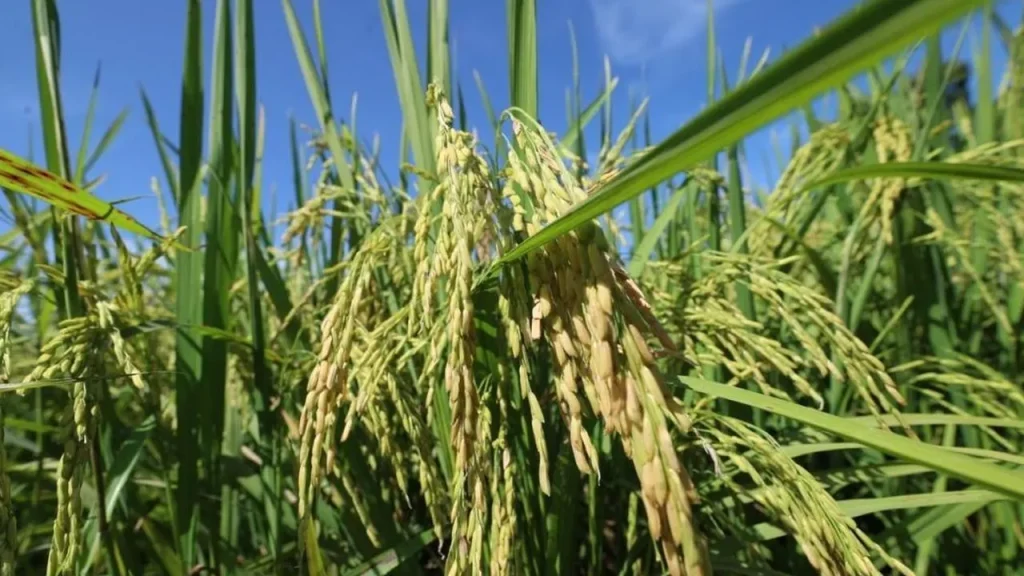
MIRI, Oct 23 2026, A perennial rice variety developed in China is showing promising results in Sarawak, raising hopes of boosting local rice production and reducing the state’s dependence on imported supplies.
Hii King Chiong, executive chairman of Borneoland Paddy Sdn Bhd, said he was overwhelmed with excitement when the company’s experimental rice fields turned golden during the first harvest.
Several months after the initial harvest on Aug 6, the rice plants are growing well, with the second harvest expected in just over a month, according to Xinhua.
The trial site in Miri was previously swampy land before Borneoland Paddy collaborated with researchers from China’s Yunnan University to explore the potential of perennial rice cultivation.
At the first harvest ceremony, Sarawak Premier Tan Sri Abang Johari Tun Openg said widespread adoption of the technology could significantly increase the state’s rice self-sufficiency level (SSL) and potentially enable Sarawak to become a rice exporter.
Sarawak currently produces only about 21 per cent of its rice requirements locally, with the state government targeting an increase to 60 per cent by 2030.
The collaboration began in 2025, building on existing ties between Sarawak and China’s Yunnan province, as well as academic exchanges between Yunnan University and Universiti Malaysia Sarawak (UNIMAS).
Hii said he had approached several expert teams to assess the challenging swamp environment before finding support from a team led by Hu Fengyi, dean of Yunnan University’s College of Agriculture.
In March, researchers began testing 30 perennial rice varieties, providing practical guidance on land preparation, irrigation and drainage systems, seed sowing, transplanting, water and fertiliser management, and pest control.
Following the first harvest, five varieties were identified as showing encouraging adaptability to local conditions.
Among them, Yunda 28 recorded a yield of more than 500 kilogrammes per mu, compared with approximately 200 kilogrammes per mu for traditional local rice varieties. One mu is equivalent to about 667 square metres.
Hu explained that perennial rice can regrow after harvesting because shoots emerge from underground stems. This characteristic could reduce the need to sow seeds, raise seedlings and replant rice for every new growing season.
However, researchers stressed that further trials are needed to determine whether the varieties can maintain consistent yields across successive harvests and adapt to Sarawak’s climate, soil and water conditions over the long term.
Hu said agricultural technologies must be adapted to local environments rather than transferred directly from one region to another. Further improvements are needed to increase yields, improve rice quality and meet Malaysia’s agricultural needs.
The partnership is expected to expand, with Abang Johari expressing interest in strengthening cooperation with Yunnan University and establishing a perennial rice research centre in Sarawak.
In early October, a Malaysian delegation visited Yunnan University to learn about its research facilities and equipment.
The experimental fields in Miri have also attracted growing public interest, with visitors eager to learn about the new Chinese-developed rice varieties.
The collaboration offers a potential pathway for Sarawak to strengthen domestic rice production, although its long-term contribution to food security will depend on further testing and successful adaptation to local conditions.
-AWANI