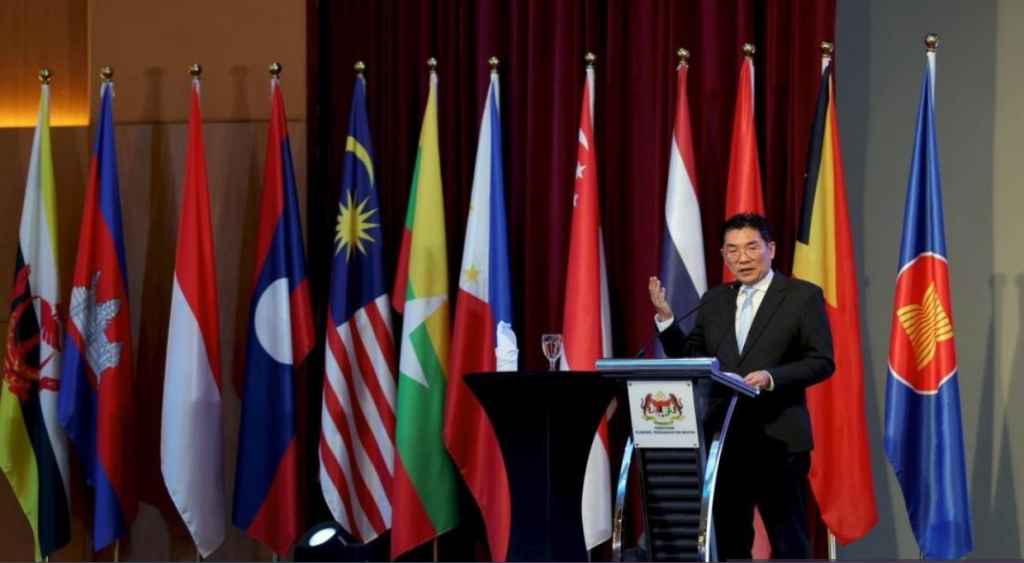
KUALA LUMPUR, November 3 – Malaysian businesses could gain access to wider regional markets through the upcoming ASEAN Digital Economy Framework Agreement (DEFA).
The agreement, scheduled for signing in November 2026, is expected to create new opportunities for local companies to sell and export their products and services across ASEAN.
The regional market covers around 690 million people, offering Malaysian businesses a larger customer base.
Deputy Investment, Trade and Industry Minister Sim Tze Tzin said the government is encouraging local companies to expand their services across the region.
He identified the Philippines, Indonesia, Thailand and Vietnam as potential markets, particularly for banking and information technology services.
Malaysian Companies Must Prepare for Greater Competition
Sim said DEFA would also create more competition in Malaysia’s domestic market.
Businesses from other ASEAN countries will have greater opportunities to offer their products and services to Malaysian consumers.
He urged local companies in the services and manufacturing sectors to prepare for these changes.
He also encouraged them to explore new markets, improve their business capabilities and increase exports.
Sim made the remarks after launching the ASEAN International Fair for Trade in Services (AIFTIS) 2026.
The event was held alongside the China-Malaysia Intelligent Industry Expo (CMIIE).
Malaysia’s Services Trade Records RM5.3 Billion Surplus
Malaysia’s services trade is expected to maintain strong growth in 2026, supported partly by data centre-related activities.
Sim said the country’s total services trade reached RM550.5 billion in 2025.
Services exports increased by 15.6 per cent to RM277.9 billion. Meanwhile, imports stood at RM272.6 billion.
This resulted in a trade surplus of RM5.3 billion. It was Malaysia’s first services trade surplus since 2011.
Focus on High-Value Digital and Professional Services
Sim said Malaysia must strengthen local expertise and develop more specialised technical talent.
He stressed that the country should not remain a market that simply consumes advanced technology.
Instead, Malaysian companies should learn to evaluate, adapt and develop new technologies for regional and global markets.
He also highlighted the need for stronger cooperation across ASEAN and China.
This includes reducing regulatory barriers, aligning professional standards and improving digital connections between markets.
Sim said Malaysian businesses must move beyond basic services and focus on higher-value activities.
These include advanced engineering, data governance, applied artificial intelligence (AI), intellectual property development and strategic consultancy.
The move could help local companies become more competitive and secure stronger positions in the regional digital economy.
Source : BERNAMABIZ | Rewritten By Minutesmy