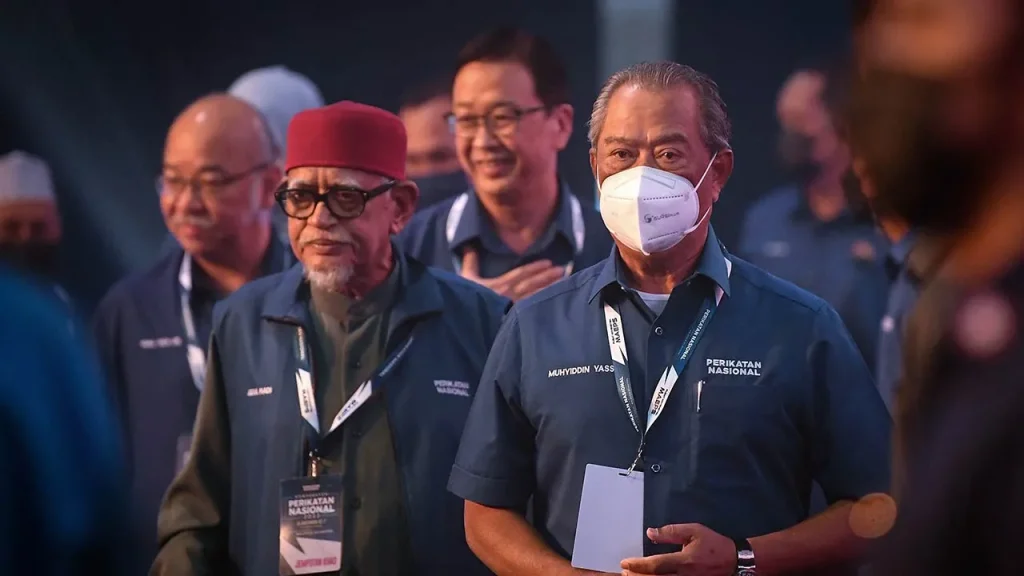
KUALA LUMPUR: PAS is likely to leave or be expelled from the Perikatan Nasional (PN) coalition after deciding to end its collaboration with Bersatu, according to political analysts.
Director of the Faculty of Social Sciences and Humanities at Universiti Teknologi Malaysia Kuala Lumpur, Associate Professor Dr Mazlan Ali, said PAS cannot determine the direction of PN alone because the political coalition also includes Bersatu, Gerakan and the Malaysian Indian People’s Party (MIPP).
“PAS only represents one voice… since PAS has severed ties with Bersatu, there is a possibility that the three component parties in PN will decide to expel PAS, and the coalition is expected to be led by Bersatu President Tan Sri Muhyiddin Yassin,” he told Bernama.
He said PAS was likely to form a new political alignment to face the next election, thus further breaking the opposition bloc.
“We will see two opposition blocs ahead of the 16th General Election (GE16), namely PN led by Bersatu and another new alignment led by PAS,” he said.
Mazlan also said the split between PAS and Bersatu could potentially give an advantage to Pakatan Harapan (PH) and Barisan Nasional (BN) if Malay support was no longer concentrated in one opposition coalition.
Yesterday, PAS President Tan Sri Abdul Hadi Awang announced that the party had officially decided to end political cooperation with Bersatu after taking into account reports, studies and current assessments of the relationship between the two parties.
Following the decision, Muhyiddin in a statement today announced that Bersatu, as the founding party of PN, will continue to remain in the coalition and strengthen the core of its struggle.
Universiti Sains Malaysia’s Centre for Social Sciences lecturer Professor Datuk Dr Sivamurugan Pandian said PAS and Bersatu were expected to face political repercussions following the decision, as well as major challenges in gaining voter support.
He said Bersatu was expected to be more affected because it relied heavily on the strength of the PAS machinery and grassroots support.
“However, PAS also faces the challenge of expanding its influence in mixed areas without the support of strategic partners,” he said.
Sivamurugan said the development also created uncertainty within the opposition bloc and opened up space for other parties to formulate strategies to strengthen their positions ahead of the 16th GE.
— BERNAMA